Monday, March 03, 2014
Moved to Facebook Site: Critical Studies in Food and Culture
We have moved to a Facebook Site:
Critical Studies in Food and Culture
https://www.facebook.com/pages/Critical-Studies-in-Food-and-Culture/105508892823849
Please connect with us there!
# posted by David Michalski @ 10:05 AM

Thursday, December 20, 2012
CFP: The ASA Food Culture Studies Caucus
The ASA Food Culture Studies Caucus is actively seeking both individual papers and panel proposals for the upcoming 2013 American Studies Association Conference in Washington D.C.
The Food Culture Studies Caucus of the American Studies Association serves as a network for scholars working on projects that engage the production, consumption, and representation of food across the many disciplines th...at cohere in American Studies. This caucus views the study of food and eating culture as offering the possibility of a radically cross-disciplinary and transnational re-engagement of key topics in studies of the Americas. While
intersecting with other Food Studies communities, this caucus differs in that it offers a space for those that see food and eating culture as central to the themes that are at the forefront of American Studies, including race, class, gender and identity, immigration, community and diaspora, social and labor history, empire, globalization and state formation. While members of this caucus work in the diverse fields of literature, geography, history, cultural studies, urban studies, ethnic studies, postcolonial studies, identity studies, gender studies, visual culture, affect theory, bodily theory, and agriculture studies, among numerous others, this Caucus actively encourages collaboration across subfields and historical periods in order to develop new directions for
teaching and researching food in all of its contexts.
As such, we are seeking paper and panel proposals that explore the culture of food and eating in its many contexts, including but certainly not
limited to:
-The Pedagogy of Food and Eating
-New Methodologies, The “Archive” and Food
-Empire, Immigration, Diaspora and Foodways
-The Globalization of Food Cultures
-Food, Sexuality and Gender
-Eating, Digestion and Food through Affective, Sensory and Bodily Theory
-Food and the Study of Race
-Food and Urban Space
-Restaurants and Food in Public Space
-Social Class, The Economic Crisis, Debt and Food
-Food, Representations and Visual Culture
-Food and Material Culture Studies
-Reading Food, Food in Literature and Literary Theory
-Critical Reading of Cookbooks
-Agricultural Policy and The Study of Food
-Food-Related Activism including food and social justice, urban
agriculture, alternative food movements, etc.
-Religious Studies
We are especially encouraging proposals who take a local focus and work on food culture, food related activism or food policy in the greater Washington D.C. area.
Individual Abstracts must be no more than 500 words.
Panel proposals must include 3-4 presenters, with abstracts (500 word maximum) accompanying each as well as an abstract for the panel as a whole (400 word maximum).
Both Paper and Panel Abstracts are due by January 4, 2012
Please submit all abstracts and direct all questions to
FoodCaucus@gmail.com
John M Burdick
Transnational Studies
State University of New York at Buffalo
burdick5@buffalo.edu
The Food Culture Studies Caucus of the American Studies Association serves as a network for scholars working on projects that engage the production, consumption, and representation of food across the many disciplines th...at cohere in American Studies. This caucus views the study of food and eating culture as offering the possibility of a radically cross-disciplinary and transnational re-engagement of key topics in studies of the Americas. While
intersecting with other Food Studies communities, this caucus differs in that it offers a space for those that see food and eating culture as central to the themes that are at the forefront of American Studies, including race, class, gender and identity, immigration, community and diaspora, social and labor history, empire, globalization and state formation. While members of this caucus work in the diverse fields of literature, geography, history, cultural studies, urban studies, ethnic studies, postcolonial studies, identity studies, gender studies, visual culture, affect theory, bodily theory, and agriculture studies, among numerous others, this Caucus actively encourages collaboration across subfields and historical periods in order to develop new directions for
teaching and researching food in all of its contexts.
As such, we are seeking paper and panel proposals that explore the culture of food and eating in its many contexts, including but certainly not
limited to:
-The Pedagogy of Food and Eating
-New Methodologies, The “Archive” and Food
-Empire, Immigration, Diaspora and Foodways
-The Globalization of Food Cultures
-Food, Sexuality and Gender
-Eating, Digestion and Food through Affective, Sensory and Bodily Theory
-Food and the Study of Race
-Food and Urban Space
-Restaurants and Food in Public Space
-Social Class, The Economic Crisis, Debt and Food
-Food, Representations and Visual Culture
-Food and Material Culture Studies
-Reading Food, Food in Literature and Literary Theory
-Critical Reading of Cookbooks
-Agricultural Policy and The Study of Food
-Food-Related Activism including food and social justice, urban
agriculture, alternative food movements, etc.
-Religious Studies
We are especially encouraging proposals who take a local focus and work on food culture, food related activism or food policy in the greater Washington D.C. area.
Individual Abstracts must be no more than 500 words.
Panel proposals must include 3-4 presenters, with abstracts (500 word maximum) accompanying each as well as an abstract for the panel as a whole (400 word maximum).
Both Paper and Panel Abstracts are due by January 4, 2012
Please submit all abstracts and direct all questions to
FoodCaucus@gmail.com
John M Burdick
Transnational Studies
State University of New York at Buffalo
burdick5@buffalo.edu
# posted by David Michalski @ 11:49 AM
CFP: Gleaning, special issue of CuiZine
Call for Papers: Gleaning
CuiZine: The Journal of Canadian Food Studies, a peer-reviewed e-journal published by McGill Library.
Gleaning: is it a political stance? a tradition? a means of mitigating food insecurity? is it
legal? CuiZine is seeking scholarly articles (2,500-3,500 words) on the history,
practice, and definition(s) of gleaning in a Canadian context. We invite
submissions from a variety of disciplinary perspectives: law, urban planning,
sociology, history, literature, folklore, geography, cultural studies.
legal? CuiZine is seeking scholarly articles (2,500-3,500 words) on the history,
practice, and definition(s) of gleaning in a Canadian context. We invite
submissions from a variety of disciplinary perspectives: law, urban planning,
sociology, history, literature, folklore, geography, cultural studies.
CuiZine is also soliciting French and English language studies of urban agriculture: community gardens, rooftop gardens, food deserts, landscape architecture, livestock keeping. We ask, what are the aesthetics, discourses, and initiatives of/in urban agriculture?
Creative pieces, interviews, and articles on related topics are also welcome. Please send 250-word abstracts along with a short CV to cuizine.info@mcgill.ca by 20 February 2013. For more info, visit our website and read past issues at cuizine.mcgill.ca.
-
Le glanage: est-ce une position politique? une tradition? un moyen d’atténuer l¹insécurité alimentaire? Est-ce légal comme pratique? CuiZine souhaite recevoir des articles en Français et en Anglais (entre 2500 et 3500 mots) à propos du glanage - histoire, pratique, définition — dans un contexte Canadien. Nous aimerions avoir des propositions multidisciplinaires: loi, paysagisme, sociologie, histoire, littérature, folklore, géographie, et études culturelles.
CuiZine sollicite aussi des études sur l¹agriculture urbaine: jardins communautaires, terrasses-jardins, déserts alimentaires, paysagisme, élevage urbain. Quels sont les théories, dialogues, et initiatives éclairant l’agriculture urbaine?
Merci d’envoyer un résumé de 250 mots ainsi qu’un court CV à cuizine.info@mcgill.ca avant le 20 Février 2013. Les oeuvres de fiction, entrevues et articles sur des sujets connexes sont aussi les bienvenus.
# posted by David Michalski @ 8:56 AM
Tuesday, November 06, 2012
Traditions and Transformations: An Interdisciplinary Food Studies Conference
Traditions and Transformations: An Interdisciplinary Food Studies Conference
Saturday, April 20, 2013
California State University, Fullerton
Department of Liberal Studies
This conference examines the state of interdisciplinary food studies by focusing on the relationships between traditions and transformations of foodways and cuisines.
We are looking for papers that examine questions surrounding food traditions and traditional foodways such as:
Who decides on the authenticity of “traditional” food and foodways? (Home cooks? Cookbook authors? Chefs?)
How are food traditions constructed through cookbooks and culinary literature? How does culinary tourism fit in? Gastronomy?
How do particular foods become associated with nations or peoples?
What role might literature or art play in identifying or codifying food traditions?
Are traditional modes of food production and consumption sustainable? (environmentally, socially, politically)
We are also looking for papers that address questions surrounding transformations in foodways:
How have global food systems impacted local food traditions? (India’s new vegetarian McDonalds?)
Are new, globalized food traditions emerging? (cosmopolitan cuisine? KFC as a new global food tradition?)
How are new foods and foodways made available to global consumers? (magazines, food tourism, restaurants, ethnic markets)
Who has access to the food traditions of the world and who does not? (food politics, distribution)
Is a globalized food system sustainable? (environmentally, socially, politically)
One page abstracts for individual papers should be sent to April Bullock (abullock@fullerton.edu) no later than December 15, 2012. Panel submissions are also welcome, please send the abstracts in one email along with contact information for each panelist. We will also be hosting food studies related events on April 18th and 19th, more information can be sent to anyone who is interested in attending.
Saturday, April 20, 2013
California State University, Fullerton
Department of Liberal Studies
This conference examines the state of interdisciplinary food studies by focusing on the relationships between traditions and transformations of foodways and cuisines.
We are looking for papers that examine questions surrounding food traditions and traditional foodways such as:
Who decides on the authenticity of “traditional” food and foodways? (Home cooks? Cookbook authors? Chefs?)
How are food traditions constructed through cookbooks and culinary literature? How does culinary tourism fit in? Gastronomy?
How do particular foods become associated with nations or peoples?
What role might literature or art play in identifying or codifying food traditions?
Are traditional modes of food production and consumption sustainable? (environmentally, socially, politically)
We are also looking for papers that address questions surrounding transformations in foodways:
How have global food systems impacted local food traditions? (India’s new vegetarian McDonalds?)
Are new, globalized food traditions emerging? (cosmopolitan cuisine? KFC as a new global food tradition?)
How are new foods and foodways made available to global consumers? (magazines, food tourism, restaurants, ethnic markets)
Who has access to the food traditions of the world and who does not? (food politics, distribution)
Is a globalized food system sustainable? (environmentally, socially, politically)
One page abstracts for individual papers should be sent to April Bullock (abullock@fullerton.edu) no later than December 15, 2012. Panel submissions are also welcome, please send the abstracts in one email along with contact information for each panelist. We will also be hosting food studies related events on April 18th and 19th, more information can be sent to anyone who is interested in attending.
# posted by David Michalski @ 3:05 PM
Thursday, September 20, 2012
CFP: Eastern Sociological Society Mini-Conference on Food Studies
Call for Abstracts
Eastern Sociological Society Mini-Conference on Food Studies
Boston, MA March 24, 2013
Submission Deadline: December 15, 2012
We invite submissions of abstracts for a mini-conference on food studies, to be held in Boston on March 24, 2013, during the annual meeting of Eastern Sociological Society.
This mini-conference seeks to bring together researchers investigating the role food, cooking and eating practices play in culture. Papers by faculty and graduate students are welcome. By definition, the reach of food is extensive and we will consider abstracts on a wide range of topics, but are especially interested in submissions that address the following themes: Food as symbol: This session will focus on the use of food and eating as symbolic practices in literature, visual arts, and popular culture.
Papers on food and the body, including eating disorders, obesity and standards of beauty as related to food and explorations of food as a nurturing practice are welcomed. Food as intersection: Food is often at the center of culture, marking the difference between “us” and “them” and is a logical place to discuss immigration, migration, globalization, political economy, sustainability and ethnic differences. At the same time, food also lends itself to an intersectional analysis.
We are seeking submissions that explore food and food practices and that allow for an examination of race, class, gender, sexuality, nationality, ethnicity and/or religion.
Food as education: As an aspect of culture, food is a tool of socialization whether it is teaching cultural and socioeconomic mobility through table manners or waging public health campaigns on topics ranging from portion size to obesity. Food is used in the classroom whether writing about food, learning math through recipes or teaching environmentalism with a community garden.
Papers that address the educational aspects of food or the effects of food scarcity or insecurity on education will receive special attention. In addition, papers that explore how food can be used as a teaching tool will also be welcomed.
Please email abstracts to ESSFoodSession@gmail.com.
Authors will be notified of the status of their submissions by January 15, 2013; full drafts of accepted papers will be due by March 1, 2013. Participants will be responsible for covering their own expenses, including ESS registration fees.
Any questions concerning the conference should be directed to ESSFoodSession@gmail.com.
For more information on the ESS Annual Meeting, see http://www.essnet.org/annualmeeting_call.aspx.
We look forward to a stimulating discussion! Sincerely, Barbara Katz Rothman & Alexandrea Ravenelle, Organizers Department of Sociology The Graduate Center, CUNY
Eastern Sociological Society Mini-Conference on Food Studies
Boston, MA March 24, 2013
Submission Deadline: December 15, 2012
We invite submissions of abstracts for a mini-conference on food studies, to be held in Boston on March 24, 2013, during the annual meeting of Eastern Sociological Society.
This mini-conference seeks to bring together researchers investigating the role food, cooking and eating practices play in culture. Papers by faculty and graduate students are welcome. By definition, the reach of food is extensive and we will consider abstracts on a wide range of topics, but are especially interested in submissions that address the following themes: Food as symbol: This session will focus on the use of food and eating as symbolic practices in literature, visual arts, and popular culture.
Papers on food and the body, including eating disorders, obesity and standards of beauty as related to food and explorations of food as a nurturing practice are welcomed. Food as intersection: Food is often at the center of culture, marking the difference between “us” and “them” and is a logical place to discuss immigration, migration, globalization, political economy, sustainability and ethnic differences. At the same time, food also lends itself to an intersectional analysis.
We are seeking submissions that explore food and food practices and that allow for an examination of race, class, gender, sexuality, nationality, ethnicity and/or religion.
Food as education: As an aspect of culture, food is a tool of socialization whether it is teaching cultural and socioeconomic mobility through table manners or waging public health campaigns on topics ranging from portion size to obesity. Food is used in the classroom whether writing about food, learning math through recipes or teaching environmentalism with a community garden.
Papers that address the educational aspects of food or the effects of food scarcity or insecurity on education will receive special attention. In addition, papers that explore how food can be used as a teaching tool will also be welcomed.
Please email abstracts to ESSFoodSession@gmail.com.
Authors will be notified of the status of their submissions by January 15, 2013; full drafts of accepted papers will be due by March 1, 2013. Participants will be responsible for covering their own expenses, including ESS registration fees.
Any questions concerning the conference should be directed to ESSFoodSession@gmail.com.
For more information on the ESS Annual Meeting, see http://www.essnet.org/annualmeeting_call.aspx.
We look forward to a stimulating discussion! Sincerely, Barbara Katz Rothman & Alexandrea Ravenelle, Organizers Department of Sociology The Graduate Center, CUNY
# posted by David Michalski @ 5:19 PM
Wednesday, August 22, 2012
Call for Papers - Teaching Food
Transformations:The Journal of Inclusive Scholarship and Pedagogy
Call for Papers - Teaching Food
Guest editors: Deirdre J. Murphy with Ada Ortuzar-Young
Deadline: September 15, 2012
The editors seek jargon-free articles (5,000-10,000 words) and media essays
(overviews on books, film, video, performance, art, music, websites, etc.
3,000 to 5,000 words) and items for an occasional feature, "The Material
Culture of Teaching," that explore the uses of food in all pedagogical
contexts and disciplinary perspectives.
The availability of food has shaped civilizations, motivated explorations,
trade and imperialism, and has prompted technological advances. From iconic
representations, to unease over the state of the current global food
system, to culinary fads or concerns for health, food is at the forefront
of public and personal debates, and it has become a powerful site of
analysis in the practice of teaching.
Submissions should explore strategies for teaching about in the
classroom and in non-traditional spaces (such as the media and public
discourse). We welcome essays from all disciplinary and interdisciplinary
perspectives.
Possible topics for articles:
. Food as sensory history
. Food traditions and rituals in anthropology, literature, cultural
studies, etc.
. Explorations of food as a nurturing practice
. Food in ethnic, im/migration, and/or area studies
. Teaching nutrition in schools and public health campaigns
. Teaching food and race, class, gender, sexuality, nationality, and/or
religion
. Food scarcity, food insecurity, and education
. Teaching histories and studies of farming and agricultural production.
. Teaching food and the body---eating disorders, obesity, beauty standards.
. Teaching food and sustainability.
. Food and the commodification of education.
. Teaching about writing about food
. Food, migration, globalization, and political economy.
. Food and eating as symbolic practices in literature, visual arts, and
popular culture.
. Teaching using recipes.
. Teaching cultural and class mobility through table manners and etiquette.
Transformations: The Journal of Inclusive Scholarship and Pedagogy is a
peer-reviewed interdisciplinary forum for pedagogical scholarship exploring
intersections of identities, power, and social justice. The journal
features a range of approaches --- from theoretical articles to creative
and experimental accounts of pedagogical innovations from teachers and
scholars from all areas of education. Transformations is published
semi-annually by New Jersey City University.
Send submissions or inquiries as attachments in MS Word or Rich Text format
to: Jacqueline Ellis and Ellen Gruber Garvey, Editors,
transformations@njcu.edu. Author's name and contact information should be
included on a separate page. Use MLA format (7th ed.). All submissions are
acknowledged via return email. Kindly follow up with us if we do not
acknowledge receipt.
# posted by David Michalski @ 12:11 AM
Wednesday, May 02, 2012
CSFC Event: Eat, Dwell, Orient: Asian / American Food Networks
The Critical Studies in Food and Culture Research Cluster Presents
“Eat, Dwell, Orient: Asian / American Food Networks”
a talk by Dr. Anita Mannur
Assistant Professor of English and Asian American Studies Miami University, Ohio
Dr. Mannur will present her work on food blogging, gender and race on the internet, and the construction of white femininity through and against brown bodies and Asian cuisine, as found in Julie Powell’s Julie and Julia, and Nani Power’s Ginger and Ganesh.
THURSDAY May 3rd 12-2p ANDREWS CONFERENCE ROOM – 2203 Social Sciences & Humanities
University of California, Davis
# posted by David Michalski @ 2:51 PM
Monday, April 16, 2012
CFP: Building Communities through Food
Building Communities through Food: From Culinary Impact of Immigrant
Communities to Social Media
DEADLINE will be 22 APRIL 2012
The literature surrounding food from all nations expresses a longing for
cultural identity, and a means to consolidate ones place in one's new home.
This panel looks at how food, and the writing that surrounds it adapts to
this migrating process. Why does food hold such a strong sense of place?
How do migrants experience the "authentic" tastes of their new homes? In
what way to migrants create their own creolised food cultures in their new
homes? Are food cultures created on-line and through other media such as
books and programs strong enough to maintain the differences that make them
unique and socially powerful? This panel promotes the analysis of cultural,
social, and political issues concerning the production, distribution,
representation, and consumption of food from a variety of disciplines and
critical perspectives.
http://www.pamla.org/2012/topics/building-communities-through-food-culinary-impact-immigrant-communities-social-media
www.pamla.org/2012
Communities to Social Media
DEADLINE will be 22 APRIL 2012
The literature surrounding food from all nations expresses a longing for
cultural identity, and a means to consolidate ones place in one's new home.
This panel looks at how food, and the writing that surrounds it adapts to
this migrating process. Why does food hold such a strong sense of place?
How do migrants experience the "authentic" tastes of their new homes? In
what way to migrants create their own creolised food cultures in their new
homes? Are food cultures created on-line and through other media such as
books and programs strong enough to maintain the differences that make them
unique and socially powerful? This panel promotes the analysis of cultural,
social, and political issues concerning the production, distribution,
representation, and consumption of food from a variety of disciplines and
critical perspectives.
http://www.pamla.org/2012/topics/building-communities-through-food-culinary-impact-immigrant-communities-social-media
www.pamla.org/2012
# posted by David Michalski @ 2:51 PM
Thursday, March 22, 2012
The Language of Food: Exploring Representations of the Culinary in Culture
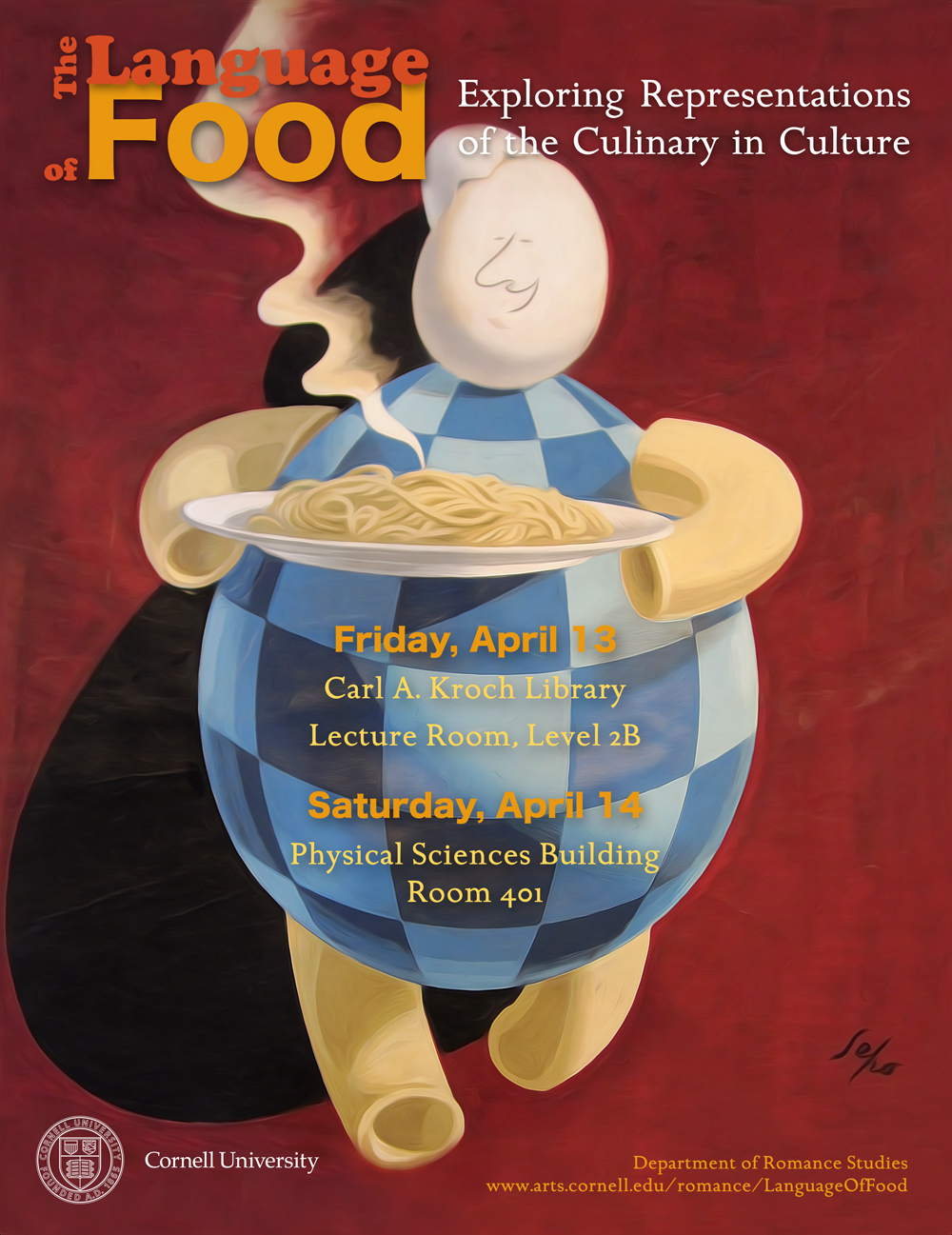
The Language of Food:
Exploring Representations of the Culinary in Culture
Friday, April 13 at 8:30am
Carl A. Kroch Library Lecture Room, Level 2B
and
Saturday, April 14 at 8:30am
Physical Sciences Building Room 401
Cornell University
Brillat-Savarin asserted that what we eat speaks volumes about who we are. This conference pushes the axiom further, asserting that it is not only what we eat, but also how we represent nourishment in art, literature, and visual culture that provides critical information. We will examine how food and representations of the culinary function as a sort of language.
The language of food, at once material and abstract, permits us to approach intangible meanings through the study of concrete objects and media. Organized around this general topic, we seek to explore the artistic, literary, historical, and sociological perspectives that use the culinary as a means to understand culture.
Please note that all conference events will be limited to the first 75 attendees. A complete schedule and registration is available at:
http://www.arts.cornell.edu/romance/LanguageOfFood/index.html
# posted by David Michalski @ 12:04 PM
Tuesday, February 07, 2012
CFP: Wine Culture in the Transnational World Panel
Wine Culture in the Transnational World
Call for Presentations:
Panel: Wine Culture in the Transnational World
I am assembling a panel on wine culture and globalization for the Foodways, Diasporic Diners, Transnational, Tables, and Culinary Connections Conference to be held in Toronto, Thursday October 4 - Sunday, October 7, 2012. This is the annual conference of the Centre for Diaspora and Transnational Studies at the University of Toronto. http://www.utoronto.ca/cdts/
I am interested in showcasing work that introduces critical concepts to the study of wine culture and society. How is our understanding of the wine trade, wine aesthetics, wine science, or wine geography developed by the interventions of cultural studies, feminism, critical race theory or other variations of critical theory? And what can the social and cultural study of wine, its changing forms, networks and practices, reveal about processes and structures of contemporary social life?
A few potential topics:
Navigating wine’s local and global networks
Changing technologies and traditions,
The labor processes and structure of expertise of global wine
Consumer behavior, status and class,
The performance of taste and power across cultures
New wine communities / wine and development
The ecologies of the wine industry and wine tourism
Global semiotics of wine markets
The cultural and political economies of good taste
See the conference call for papers for more ideas:
http://www.utoronto.ca/cdts/pdf_doc/Food%20conference.pdf
My own contribution to the panel examines the social importance of wine in consumer society by historicizing its promise and appeal in relation to the crises which accompany globalization.
Please send titles, abstracts (200 words), and contact information to me by March 1, 2012
Send to:
David Michalski
University of California, Davis
michalski@ucdavis.edu
Call for Presentations:
Panel: Wine Culture in the Transnational World
I am assembling a panel on wine culture and globalization for the Foodways, Diasporic Diners, Transnational, Tables, and Culinary Connections Conference to be held in Toronto, Thursday October 4 - Sunday, October 7, 2012. This is the annual conference of the Centre for Diaspora and Transnational Studies at the University of Toronto. http://www.utoronto.ca/cdts/
I am interested in showcasing work that introduces critical concepts to the study of wine culture and society. How is our understanding of the wine trade, wine aesthetics, wine science, or wine geography developed by the interventions of cultural studies, feminism, critical race theory or other variations of critical theory? And what can the social and cultural study of wine, its changing forms, networks and practices, reveal about processes and structures of contemporary social life?
A few potential topics:
Navigating wine’s local and global networks
Changing technologies and traditions,
The labor processes and structure of expertise of global wine
Consumer behavior, status and class,
The performance of taste and power across cultures
New wine communities / wine and development
The ecologies of the wine industry and wine tourism
Global semiotics of wine markets
The cultural and political economies of good taste
See the conference call for papers for more ideas:
http://www.utoronto.ca/cdts/pdf_doc/Food%20conference.pdf
My own contribution to the panel examines the social importance of wine in consumer society by historicizing its promise and appeal in relation to the crises which accompany globalization.
Please send titles, abstracts (200 words), and contact information to me by March 1, 2012
Send to:
David Michalski
University of California, Davis
michalski@ucdavis.edu
# posted by David Michalski @ 10:31 AM
Monday, February 06, 2012
CFP: Food, Migration, and Movement
Call for Submissions: Food, Migration, and Movement
Deadline Extended to March 1st.
Food is a common and constant variable among us; everyone must eat.
Vandal is looking for fiction, non-fiction, poetry, essays, photographs,
interviews and visual art that engages the theme: food, migration, and
... movement.
We interpret this call as broadly as possible, to include all topics
that deal with food/foodways, and migration or political movement(s).
The movement of food(s) and people(s) has always intimately connected
politics, culture, and identity, marking ‘us’ and ‘them’. Food
migrations are surely among the most globally transformative moments in
recorded history. Christopher Columbus sailed in search of spices, and
sugar was inextricable in the trade triangle that brought so many
enslaved Africans to the “New World.” Sugar, coffee and cocoa remain
among the most traded commodities worldwide. As food often reflects
public policy’s focus, food also becomes the vehicle through which we
voice our politics. These expressions can be witnessed in government
corn subsidies, hunger strikes, the establishment of local community
farms and protests on every continent resulting from rising food prices
within the last year. Our options or lack of options in food ultimately
effect health and culture. To engage food is to engage the most crucial
aspects of all societies.
Please submit to: foodmigration@vandaljournal.com
*Deadline: March 1, 2012
Vandal is a new literary/art journal for transformative social change
founded in 2009 in College Station, Texas and associated with Texas A&M.
It publishes scholarly and artistic fiction, non-fiction, art and
literature. For more information see:
http://www.vandaljournal.com/See more
Deadline Extended to March 1st.
Food is a common and constant variable among us; everyone must eat.
Vandal is looking for fiction, non-fiction, poetry, essays, photographs,
interviews and visual art that engages the theme: food, migration, and
... movement.
We interpret this call as broadly as possible, to include all topics
that deal with food/foodways, and migration or political movement(s).
The movement of food(s) and people(s) has always intimately connected
politics, culture, and identity, marking ‘us’ and ‘them’. Food
migrations are surely among the most globally transformative moments in
recorded history. Christopher Columbus sailed in search of spices, and
sugar was inextricable in the trade triangle that brought so many
enslaved Africans to the “New World.” Sugar, coffee and cocoa remain
among the most traded commodities worldwide. As food often reflects
public policy’s focus, food also becomes the vehicle through which we
voice our politics. These expressions can be witnessed in government
corn subsidies, hunger strikes, the establishment of local community
farms and protests on every continent resulting from rising food prices
within the last year. Our options or lack of options in food ultimately
effect health and culture. To engage food is to engage the most crucial
aspects of all societies.
Please submit to: foodmigration@vandaljournal.com
Vandal is a new literary/art journal for transformative social change
founded in 2009 in College Station, Texas and associated with Texas A&M.
It publishes scholarly and artistic fiction, non-fiction, art and
literature. For more information see:
http://www.vandaljournal.com/See more
# posted by David Michalski @ 1:56 PM
CFP: “The Food Crisis: Implications for Decent Work in Rural and Urban Areas
CALL FOR PAPERS
“The Food Crisis: Implications for Decent Work in Rural and Urban Areas”
The International Center for Development and Decent Work (ICDD) Annual
Thematic Conference – University of Kassel, Kassel, Germany, July 4-6
In recent years, food prices have gone up to prohibitive levels for
many of the world’s poor. They have remained high and volatile. While
many poor city dwellers have had to switch their diets to include only
very basic foods, the vast majority of those who are hungry in the
world today (over half a billion) are working in agriculture, either
as small landholders or as waged agricultural workers. This paradox
has sparked a lively debate about the reasons for food price
increases. However, the implications for the Decent Work agenda have
received less attention. The four dimensions of the Decent Work
concept (creating jobs, guaranteeing rights at work, extending social
protection and promoting social dialogue) do not explicitly cover the
issue of rising food prices. On the one hand, price increases for the
most basic household items threaten any gains achieved through the
Decent Work agenda. On the other hand, increased food prices may in
principle provide an opportunity for agricultural labour, yet the
majority of the food producers seem not to have benefited from rising
prices. Apparently, the bargaining power of many producers has been
weakened vis-à-vis the buyers of agricultural produce. This
development points to another dimension not explicitly addressed by
the Decent Work agenda: power relations along the food chain.
The International Center for Development and Decent Work (ICDD) wants
to commit its Annual Thematic Conference “The Food Crisis:
Implications for Decent Work in Rural and Urban Areas” to an
exploration of the origins of the food crisis, its implications for
the Decent Work agenda, and strategies for addressing the crisis.
The general themes to be discussed are:
Assessing the Scope of the Food Crisis: Is there a rural – urban
divide? What is the impact on workers and small landholders? What are
the implications for the Decent Work agenda?
Origins of the Food Crisis: Financialization, land grabbing, climate
change and soil degradation, agribusiness, agro-fuels, EU trade
policies, demography, productivity obstacles, and other relevant topics.
Remedies for the Food Crisis: Increasing agricultural productivity,
improving logistics, empowering agricultural workers, food
sovereignty, and other relevant topics.
We encourage potential contributors to include a gender-sensitive
analysis whenever possible.
If you would like to present a paper in one of these areas, please
send a brief abstract (less than half a page) by April 1, 2012 to:
ATC2012Kassel@icdd.uni-kassel.de
Please include the following information:
Name:
Country:
Organization:
-- Prof. Dr. Christoph Scherrer "Globalisierung & Politik" FB 5 - Gesellschaftswissenschaften Universität Kassel Nora-Platiel-Straße 1 D-34127 Kassel Tel.: +49 (0) 561 804 3253 Sekr. scherrer@uni-kassel.de
“The Food Crisis: Implications for Decent Work in Rural and Urban Areas”
The International Center for Development and Decent Work (ICDD) Annual
Thematic Conference – University of Kassel, Kassel, Germany, July 4-6
In recent years, food prices have gone up to prohibitive levels for
many of the world’s poor. They have remained high and volatile. While
many poor city dwellers have had to switch their diets to include only
very basic foods, the vast majority of those who are hungry in the
world today (over half a billion) are working in agriculture, either
as small landholders or as waged agricultural workers. This paradox
has sparked a lively debate about the reasons for food price
increases. However, the implications for the Decent Work agenda have
received less attention. The four dimensions of the Decent Work
concept (creating jobs, guaranteeing rights at work, extending social
protection and promoting social dialogue) do not explicitly cover the
issue of rising food prices. On the one hand, price increases for the
most basic household items threaten any gains achieved through the
Decent Work agenda. On the other hand, increased food prices may in
principle provide an opportunity for agricultural labour, yet the
majority of the food producers seem not to have benefited from rising
prices. Apparently, the bargaining power of many producers has been
weakened vis-à-vis the buyers of agricultural produce. This
development points to another dimension not explicitly addressed by
the Decent Work agenda: power relations along the food chain.
The International Center for Development and Decent Work (ICDD) wants
to commit its Annual Thematic Conference “The Food Crisis:
Implications for Decent Work in Rural and Urban Areas” to an
exploration of the origins of the food crisis, its implications for
the Decent Work agenda, and strategies for addressing the crisis.
The general themes to be discussed are:
Assessing the Scope of the Food Crisis: Is there a rural – urban
divide? What is the impact on workers and small landholders? What are
the implications for the Decent Work agenda?
Origins of the Food Crisis: Financialization, land grabbing, climate
change and soil degradation, agribusiness, agro-fuels, EU trade
policies, demography, productivity obstacles, and other relevant topics.
Remedies for the Food Crisis: Increasing agricultural productivity,
improving logistics, empowering agricultural workers, food
sovereignty, and other relevant topics.
We encourage potential contributors to include a gender-sensitive
analysis whenever possible.
If you would like to present a paper in one of these areas, please
send a brief abstract (less than half a page) by April 1, 2012 to:
ATC2012Kassel@icdd.uni-kassel.de
Please include the following information:
Name:
Country:
Organization:
-- Prof. Dr. Christoph Scherrer "Globalisierung & Politik" FB 5 - Gesellschaftswissenschaften Universität Kassel Nora-Platiel-Straße 1 D-34127 Kassel Tel.: +49 (0) 561 804 3253 Sekr. scherrer@uni-kassel.de
# posted by David Michalski @ 1:54 PM
Monday, January 30, 2012
CFP: FOODWAYS: DIASPORIC DINERS, TRANSNATIONAL TABLES AND CULINARY CONNECTIONS
FOODWAYS: DIASPORIC DINERS, TRANSNATIONAL TABLES AND CULINARY CONNECTIONS
Centre for Diaspora and Transnational Studies, University of Toronto
Please join us for the 2012 Annual Conference of the Centre for Diaspora and Transnational Studies, University of Toronto
Thursday October 4 - Sunday, October 7, 2012
Expressions of Interest due: Feb. 10
Abstracts due: Mar. 16
Also on Facebook http://www.facebook.com/pages/Foodways-Diasporic-Diners-Transnational-Tables-and-Culinary-Connections/213356948754172
Description:
This conference seeks to address questions surrounding the dynamics of the food ‘we’ eat, the ways in which ‘we’ eat, the meaning ‘we’ give to eating, and the effect of eating in a transnational world. Recognizing that culinary culture is central to diasporic identifications, the focus is on the place of food in the enduring habits, rituals, and everyday practices that are collectively used to produce and sustain a shared senses of cultural identity. Yet even as it does this work, food and the practices of production, preparation and consumption that revolve around it, cannot help but be drawn into wider cultures and cultural politics of consumption increasingly grounded in the pursuit of qualities of difference, acts of distinction and questions of justice. This focus on food, cooking, and eating in diaspora and its role in connecting and changing peoples, places, tastes, and sensibilities around the world yields insight not only to substances that people consider essential to the maintenance of identity, but to the production of new cultural political formations in a transnational world and to the role of cultural (re)production in the expansion of consumption under contemporary capitalism. A focus on food also reveals the dynamic role of historical pathways in understanding cultural formations as they have existed through time, and in positioning the present as a moment in a continuing process of structured mobility that directs the movement of people, what they eat, and how they understand themselves and the world around them. It also yields insight into the multiple places and ways in which food assumes value and how that value is often reliant upon the continued reproduction of ties that bind people, place, and practice across space and time. A great deal of academic work explores this interplay of food, practice, identity and subject formation, much of it bound together by a commitment that through a fuller understanding of those relations, we better understand ourselves, our pasts, and the complexities of the spaces and lives we inhabit and enact in a transnational world. This conference seeks to enhance that understanding.
Information:
The conference website will be available soon, with more information, registration, and online submission of abstracts. For now, to help with advance planning we would be grateful if you would submit expressions of interest.
Submitting an Expression of Interest:
We welcome contributions from scholars, activists, artists, advocates, government staff and food and agriculture practitioners and expect the meeting to have wide appeal across the Humanities and Social Sciences. Suggestions for papers, panel proposals, roundtables, posters and workshops should speak directly to the theme of the conference and can align with, but are not limited to, the examples of potential panels provided below.
To help us with advance planning, please submit expressions of interest by Feb. 10 2012. For papers and posters this should be the title of an intended paper or poster. For panel, roundtable or workshop proposals, this should include a title and brief (two sentence) description of the session. Panels should consist of 4 papers. In your expression of interest, please include your title, the name of your college, university or organization,address and contact details and your areas of research, writing or practice.
Please address your expressions of interest to Rebecca O’Neill - rebecca.oneill@utoronto.ca with the subject line “Food Conference”
For more information on the Centre for Diaspora and Transnational Studies at the University of Toronto, please see: http://www.utoronto.ca/cdts/
Possible Topics and Areas of Interest:
• The Transnational Kitchen: the role of food ‘professionals’ as transnational agents in shaping new foods, sourcing new ingredients, identifying and incorporating new ingredients and trends in preparation
• The Syncretic Pot: Cooking in Transnational Spaces. The dynamics of foodpreparation in transnational spaces and the place of cooking in negotiating shared senses of diasporic identity.
• Transnational Food Spaces: A consideration of the kitchen, the dining room, the grocery store, the garden, the café, the restaurant, the school and the workplace as sites of transculturation, spaces in which disparate representations of ‘the other’ (and ‘other foods’) are encountered, and the reconfigurations of food, eating and identity that result from these encounters.
• The Diasporic Garden: explorations of the various modes and mechanisms of production and distribution required to supply the products integral to the social and commercial production of foodstuffs for diasporic communities; including the often-invisible spaces of backyard gardens, community farms, ethnic markets, etc.
• Am I What I Eat? Transnational Flows, Food and Constructs of Authenticity: Questioning the role of authenticity in sanctioning foodstuffs and how constructs and conceptions of ‘the authentic self’ change as people strive (and often fail) to reproduce ‘authentic’ cuisines.
• Affective Bodies at the Transnational Table: Considerations of the relations between the senses, affect, food, manners and etiquette and the disciplining effect of eating in embodying and performing the qualities integral to diasporic identifications.
• Culinary Foodways: Charting the adaptation, substitution, and indigenization of ingredients, foodstuffs, and methods of preparation across time and space.
• Food Memories: Considering the work performed by food in the reproduction of sociality, myth and ritual and practice that are core to maintaining the boundaries of diasporic communities and constructs of ‘home’, ‘away’, and ‘return’.
• The Food Dialogues: Exploration of the various channels (e. g, personal correspondence, popular culture, media, professional associations, social movements) through which the transformation of diet becomes a spatially iterative process.
• Enclave Eating and Cosmo-Multiculturalism: questions of the degree to which the ready availability of diasporic foodstuffs encourages or permits a ‘lazy’ engagement with multi-culturalism in which eating ‘the foreign’ or ‘the exotic’ is focused on the production of a distinctive self and displaces other more substantive or productive forms of engagement with difference.
• Fixing Food –In what ways are diasporic foods essentialized and does the necessity of maintaining "exotic" or “authentic” foodscapes produce a distinct diasporic burden, acting to fix migrant culinary cultures - with what outcomes and effects for foods and the creativity of their makers?
• A Doner Kebab with ‘the Works’ - identifying why and through what historical processes food becomes a mediator of of ethnic identities produced in diasporic contexts.
• Where’s Little India? – a consideration of the role of food in the development of distinct "ethnic quarters”, the historical conditions in which such enclaves are produced and with what consequences for peoples working and living in those enclaves?
Advisory Committee
Lauren Baker (Toronto Food Policy Council)
Simone Cinotto, (UNISG, Pollenzo, Italy)
Ian Cook (Geography, Exeter)
Michaeline Crichlow (Sociology, Duke)
Harriet Friedmann (Geography, Toronto)
Rick Halpern (History, Toronto)
Josee Johnston (Sociology Toronto)
Minelle Mahtani (Geography and Program in Journalism, Toronto)
Sidney Mintz (Anthropology, Johns Hopkins)
Jeffrey Pilcher (History, Minnesota)
Krishnendu Ray (Food Studies, NYU)
Eleanor Sterling (Director, Centre for Biodiversity and Conservation, American Museum of Natural History; Columbia University)
Penny Van Esterik (Anthropology, York)
Rick Wilk (Anthropology, Indiana)
Local Arrangements and Organizing Committee (University of Toronto)
Ken MacDonald (Chair) (Geography, CDTS)
Antonela Arhin ( CDTS)
Dan Bender (History)
Ben Liu (Centre for Community Partnerships; Geography)
Rebecca O’Neill (History)
Kevin O’Neill (Religious Studies; CDTS)
Ato Quayson (English; CDTS)
Anna Shternshis (Germanic Languages; Jewish Studies; CDTS)
Nick Terpstra (History; CDTS)
Centre for Diaspora and Transnational Studies, University of Toronto
Please join us for the 2012 Annual Conference of the Centre for Diaspora and Transnational Studies, University of Toronto
Thursday October 4 - Sunday, October 7, 2012
Expressions of Interest due: Feb. 10
Abstracts due: Mar. 16
Also on Facebook http://www.facebook.com/pages/Foodways-Diasporic-Diners-Transnational-Tables-and-Culinary-Connections/213356948754172
Description:
This conference seeks to address questions surrounding the dynamics of the food ‘we’ eat, the ways in which ‘we’ eat, the meaning ‘we’ give to eating, and the effect of eating in a transnational world. Recognizing that culinary culture is central to diasporic identifications, the focus is on the place of food in the enduring habits, rituals, and everyday practices that are collectively used to produce and sustain a shared senses of cultural identity. Yet even as it does this work, food and the practices of production, preparation and consumption that revolve around it, cannot help but be drawn into wider cultures and cultural politics of consumption increasingly grounded in the pursuit of qualities of difference, acts of distinction and questions of justice. This focus on food, cooking, and eating in diaspora and its role in connecting and changing peoples, places, tastes, and sensibilities around the world yields insight not only to substances that people consider essential to the maintenance of identity, but to the production of new cultural political formations in a transnational world and to the role of cultural (re)production in the expansion of consumption under contemporary capitalism. A focus on food also reveals the dynamic role of historical pathways in understanding cultural formations as they have existed through time, and in positioning the present as a moment in a continuing process of structured mobility that directs the movement of people, what they eat, and how they understand themselves and the world around them. It also yields insight into the multiple places and ways in which food assumes value and how that value is often reliant upon the continued reproduction of ties that bind people, place, and practice across space and time. A great deal of academic work explores this interplay of food, practice, identity and subject formation, much of it bound together by a commitment that through a fuller understanding of those relations, we better understand ourselves, our pasts, and the complexities of the spaces and lives we inhabit and enact in a transnational world. This conference seeks to enhance that understanding.
Information:
The conference website will be available soon, with more information, registration, and online submission of abstracts. For now, to help with advance planning we would be grateful if you would submit expressions of interest.
Submitting an Expression of Interest:
We welcome contributions from scholars, activists, artists, advocates, government staff and food and agriculture practitioners and expect the meeting to have wide appeal across the Humanities and Social Sciences. Suggestions for papers, panel proposals, roundtables, posters and workshops should speak directly to the theme of the conference and can align with, but are not limited to, the examples of potential panels provided below.
To help us with advance planning, please submit expressions of interest by Feb. 10 2012. For papers and posters this should be the title of an intended paper or poster. For panel, roundtable or workshop proposals, this should include a title and brief (two sentence) description of the session. Panels should consist of 4 papers. In your expression of interest, please include your title, the name of your college, university or organization,address and contact details and your areas of research, writing or practice.
Please address your expressions of interest to Rebecca O’Neill - rebecca.oneill@utoronto.ca with the subject line “Food Conference”
For more information on the Centre for Diaspora and Transnational Studies at the University of Toronto, please see: http://www.utoronto.ca/cdts/
Possible Topics and Areas of Interest:
• The Transnational Kitchen: the role of food ‘professionals’ as transnational agents in shaping new foods, sourcing new ingredients, identifying and incorporating new ingredients and trends in preparation
• The Syncretic Pot: Cooking in Transnational Spaces. The dynamics of foodpreparation in transnational spaces and the place of cooking in negotiating shared senses of diasporic identity.
• Transnational Food Spaces: A consideration of the kitchen, the dining room, the grocery store, the garden, the café, the restaurant, the school and the workplace as sites of transculturation, spaces in which disparate representations of ‘the other’ (and ‘other foods’) are encountered, and the reconfigurations of food, eating and identity that result from these encounters.
• The Diasporic Garden: explorations of the various modes and mechanisms of production and distribution required to supply the products integral to the social and commercial production of foodstuffs for diasporic communities; including the often-invisible spaces of backyard gardens, community farms, ethnic markets, etc.
• Am I What I Eat? Transnational Flows, Food and Constructs of Authenticity: Questioning the role of authenticity in sanctioning foodstuffs and how constructs and conceptions of ‘the authentic self’ change as people strive (and often fail) to reproduce ‘authentic’ cuisines.
• Affective Bodies at the Transnational Table: Considerations of the relations between the senses, affect, food, manners and etiquette and the disciplining effect of eating in embodying and performing the qualities integral to diasporic identifications.
• Culinary Foodways: Charting the adaptation, substitution, and indigenization of ingredients, foodstuffs, and methods of preparation across time and space.
• Food Memories: Considering the work performed by food in the reproduction of sociality, myth and ritual and practice that are core to maintaining the boundaries of diasporic communities and constructs of ‘home’, ‘away’, and ‘return’.
• The Food Dialogues: Exploration of the various channels (e. g, personal correspondence, popular culture, media, professional associations, social movements) through which the transformation of diet becomes a spatially iterative process.
• Enclave Eating and Cosmo-Multiculturalism: questions of the degree to which the ready availability of diasporic foodstuffs encourages or permits a ‘lazy’ engagement with multi-culturalism in which eating ‘the foreign’ or ‘the exotic’ is focused on the production of a distinctive self and displaces other more substantive or productive forms of engagement with difference.
• Fixing Food –In what ways are diasporic foods essentialized and does the necessity of maintaining "exotic" or “authentic” foodscapes produce a distinct diasporic burden, acting to fix migrant culinary cultures - with what outcomes and effects for foods and the creativity of their makers?
• A Doner Kebab with ‘the Works’ - identifying why and through what historical processes food becomes a mediator of of ethnic identities produced in diasporic contexts.
• Where’s Little India? – a consideration of the role of food in the development of distinct "ethnic quarters”, the historical conditions in which such enclaves are produced and with what consequences for peoples working and living in those enclaves?
Advisory Committee
Lauren Baker (Toronto Food Policy Council)
Simone Cinotto, (UNISG, Pollenzo, Italy)
Ian Cook (Geography, Exeter)
Michaeline Crichlow (Sociology, Duke)
Harriet Friedmann (Geography, Toronto)
Rick Halpern (History, Toronto)
Josee Johnston (Sociology Toronto)
Minelle Mahtani (Geography and Program in Journalism, Toronto)
Sidney Mintz (Anthropology, Johns Hopkins)
Jeffrey Pilcher (History, Minnesota)
Krishnendu Ray (Food Studies, NYU)
Eleanor Sterling (Director, Centre for Biodiversity and Conservation, American Museum of Natural History; Columbia University)
Penny Van Esterik (Anthropology, York)
Rick Wilk (Anthropology, Indiana)
Local Arrangements and Organizing Committee (University of Toronto)
Ken MacDonald (Chair) (Geography, CDTS)
Antonela Arhin ( CDTS)
Dan Bender (History)
Ben Liu (Centre for Community Partnerships; Geography)
Rebecca O’Neill (History)
Kevin O’Neill (Religious Studies; CDTS)
Ato Quayson (English; CDTS)
Anna Shternshis (Germanic Languages; Jewish Studies; CDTS)
Nick Terpstra (History; CDTS)
# posted by David Michalski @ 10:15 AM
Thursday, January 12, 2012
Food and the City Conference
Food and the City Conference
February 24 – 25, 2012
Boston University
Photonics Center, Room 906
Food and the City, an initiative of Boston University’s History Department, is pleased to announce a two-day conference dedicated to a historical discussion about the relationship between food and cities. The event will encourage multi-disciplinary, global perspectives and explore how the history of feeding cities could inform the design and practices of urban food systems in the future.
http://www.bu.edu/history/news-events/conferences/food-and-the-city-conference/
February 24 – 25, 2012
Boston University
Photonics Center, Room 906
Food and the City, an initiative of Boston University’s History Department, is pleased to announce a two-day conference dedicated to a historical discussion about the relationship between food and cities. The event will encourage multi-disciplinary, global perspectives and explore how the history of feeding cities could inform the design and practices of urban food systems in the future.
http://www.bu.edu/history/news-events/conferences/food-and-the-city-conference/
# posted by David Michalski @ 1:15 PM
foodies in exile: paintings by bryce vinokurov
foodies in exile: paintings by bryce vinokurov
www.bvinokurov.com
artist statement:
For the past six years I have lived in Davis, California, a small town in Northern California, largely surrounded by agricultural fields. After ten years of living in Boston Massachusetts, my move left me feeling in exile from the urban city life I had become accustomed to. However, the inspiration of the Northern California landscape and the emergent national fixation with the sustainable food industry and culture quickly became an inspiration. As a result my largely abstract work has been populated with figures and landscapes. The subject of the work revolves a group of foodies who are not set in a specific time or space. These satirical pieces include groups of individuals on bikes, around grills, donning chef hats or handling other accessories, but with other comforts of the modern world unspecified. I enjoy the idea of these foodies exiled to an idyllic place-cooking on grills, fighting over recipes and arguing over who is the best chef. These characters battle each other with pizza peals and chef’s knives. They hold petty grudges over recipes and fight over truffle pigs. They wage war over food poisoning and have been exiled to a land that looks like Umbria, Tuscany or Napa. The foodies are nomads with grills banished to a life of locavore eating. The inspiration for the landscape these foodies in exile often find themselves in, and the composition of these groups are heavily influenced by the painters Giotto, Piero della Francesca, and Lorenzetti. For the last 4 years I have been going to Italy to teach in the summer, and the Umbrian and Tuscan landscapes and light pervade the work. The body of work includes large and small oil paintings, collages, linocuts, and intaglio etchings.
www.bvinokurov.com
artist statement:
For the past six years I have lived in Davis, California, a small town in Northern California, largely surrounded by agricultural fields. After ten years of living in Boston Massachusetts, my move left me feeling in exile from the urban city life I had become accustomed to. However, the inspiration of the Northern California landscape and the emergent national fixation with the sustainable food industry and culture quickly became an inspiration. As a result my largely abstract work has been populated with figures and landscapes. The subject of the work revolves a group of foodies who are not set in a specific time or space. These satirical pieces include groups of individuals on bikes, around grills, donning chef hats or handling other accessories, but with other comforts of the modern world unspecified. I enjoy the idea of these foodies exiled to an idyllic place-cooking on grills, fighting over recipes and arguing over who is the best chef. These characters battle each other with pizza peals and chef’s knives. They hold petty grudges over recipes and fight over truffle pigs. They wage war over food poisoning and have been exiled to a land that looks like Umbria, Tuscany or Napa. The foodies are nomads with grills banished to a life of locavore eating. The inspiration for the landscape these foodies in exile often find themselves in, and the composition of these groups are heavily influenced by the painters Giotto, Piero della Francesca, and Lorenzetti. For the last 4 years I have been going to Italy to teach in the summer, and the Umbrian and Tuscan landscapes and light pervade the work. The body of work includes large and small oil paintings, collages, linocuts, and intaglio etchings.
# posted by David Michalski @ 1:04 PM
Friday, January 06, 2012
New Book: Taking food public : redefining foodways in a changing world
Taking food public : redefining foodways in a changing world / edited by Psyche Williams Forson, Carole Counihan.
Published New York : Routledge, 2012.
Description xiv, 635 p. : ill. ; 26 cm.
Record format BK Book
BI Books with illustrations
Check Availability All items
Call no. Shields Library GT2850 .T326 2012 In process
Bibliography Includes bibliographical references and index.
Contents Taking food public / Psyche Williams-Forson and Carole Counihan -- Food industrialisation and food power: implications for food governance / Tim Lang -- Women and food chains: the gendered politics of food / Patricia Allen and Carolyn Sachs -- Can we sustain sustainable agriculture? Learning from small-scale producer-suppliers in Canada and the UK / Larch Maxey -- Things became scarce: food availability and accessibility in Santiago de Cuba then and now / Hanna Garth -- Capitalism and its discontents: back-to-the-lander and freegan foodways in rural Oregon / Joan Gross -- Cultural geographies in practice. The south central farm: dilemmas in practicing the public / Laura Lawson -- Charlas culinarias: Mexican women speak from their public kitchens / Meredeith E. Abarca -- Inequality in obesigenic environments: fast food density in New York City / Naa Oyo A. Kwate, Chun-Yip Yau, Ji-Meng Loh, and Donya Williams --
Physical disabilities and food access among limited resource households / Caroline B. Webber, Jeffery Sobal, and Jaime S. Dollahite -- Other women cooked for my husband: negotiating gender, food, and identities in an African American/Ghanian household / Pysche Williams-Forson -- Going beyond the normative White "post-racial" Vegan epistemology / A. Breeze Harper -- Purity, soul food, and Sunni Islam: explorations at the intersection of consumption and resistance / Carolyn Rouse and Janet Hoskins -- Cleaning from gluttony: an Australian youth subculture confronts the ethics of waste / Ferne Edwards and David Mercer -- "If they only knew": color blindness and universalism in California alternative food institutions / Julie Guthman -- Feeding desire: food, domesticity, and challenges to hetero-patriarchy / Anita Mannur -- Towards queering food studies: foodways, heteronormativity, and hungry women in Chicana lesbian writing / Julia C. Ehrhardt --
Metrosexuality can stuff it: beef consumption as (heteromasculine) fortification / C. Wesley Buerkle -- "Please pass the chicken tits": rethinking men and cooking at an urban firehouse / Jonathan Deutsch -- The magic metabolisms of competitive eating / Adrienne Rose Johnson -- Vintage breast milk: exploring the discursive limits of feminine fluids / Penny Van Esterik -- Do the hands that feed us hold us back? Implications of assisted eating / G. Denise Lance -- Will tweet for food: microblogging mobile food trucks--online, offline, and in line / Alison Caldwell -- Visualizing 21st-century foodscapes: using photographs and new media in food studies / Melissa L. Salazar --
Published New York : Routledge, 2012.
Description xiv, 635 p. : ill. ; 26 cm.
Record format BK Book
BI Books with illustrations
Check Availability All items
Call no. Shields Library GT2850 .T326 2012 In process
Bibliography Includes bibliographical references and index.
Contents Taking food public / Psyche Williams-Forson and Carole Counihan -- Food industrialisation and food power: implications for food governance / Tim Lang -- Women and food chains: the gendered politics of food / Patricia Allen and Carolyn Sachs -- Can we sustain sustainable agriculture? Learning from small-scale producer-suppliers in Canada and the UK / Larch Maxey -- Things became scarce: food availability and accessibility in Santiago de Cuba then and now / Hanna Garth -- Capitalism and its discontents: back-to-the-lander and freegan foodways in rural Oregon / Joan Gross -- Cultural geographies in practice. The south central farm: dilemmas in practicing the public / Laura Lawson -- Charlas culinarias: Mexican women speak from their public kitchens / Meredeith E. Abarca -- Inequality in obesigenic environments: fast food density in New York City / Naa Oyo A. Kwate, Chun-Yip Yau, Ji-Meng Loh, and Donya Williams --
Physical disabilities and food access among limited resource households / Caroline B. Webber, Jeffery Sobal, and Jaime S. Dollahite -- Other women cooked for my husband: negotiating gender, food, and identities in an African American/Ghanian household / Pysche Williams-Forson -- Going beyond the normative White "post-racial" Vegan epistemology / A. Breeze Harper -- Purity, soul food, and Sunni Islam: explorations at the intersection of consumption and resistance / Carolyn Rouse and Janet Hoskins -- Cleaning from gluttony: an Australian youth subculture confronts the ethics of waste / Ferne Edwards and David Mercer -- "If they only knew": color blindness and universalism in California alternative food institutions / Julie Guthman -- Feeding desire: food, domesticity, and challenges to hetero-patriarchy / Anita Mannur -- Towards queering food studies: foodways, heteronormativity, and hungry women in Chicana lesbian writing / Julia C. Ehrhardt --
Metrosexuality can stuff it: beef consumption as (heteromasculine) fortification / C. Wesley Buerkle -- "Please pass the chicken tits": rethinking men and cooking at an urban firehouse / Jonathan Deutsch -- The magic metabolisms of competitive eating / Adrienne Rose Johnson -- Vintage breast milk: exploring the discursive limits of feminine fluids / Penny Van Esterik -- Do the hands that feed us hold us back? Implications of assisted eating / G. Denise Lance -- Will tweet for food: microblogging mobile food trucks--online, offline, and in line / Alison Caldwell -- Visualizing 21st-century foodscapes: using photographs and new media in food studies / Melissa L. Salazar --
# posted by David Michalski @ 12:52 PM
Tuesday, January 03, 2012
CFP: Food, Migration, and Movement
Call for Submissions: Food, Migration, and Movement
Food is a common and constant variable among us; everyone must eat. Vandal
is looking for fiction, non-fiction, poetry, essays, photographs,
interviews and visual art that engages the theme: food, migration, and
movement.
We interpret this call as broadly as possible, to include all topics that
deal with food/foodways, and migration or political movement(s). The
movement of food(s) and people(s) has always intimately connected politics,
culture, and identity, marking ‘us’ and ‘them’. Food migrations are surely
among the most globally transformative moments in recorded history.
Christopher Columbus sailed in search of spices, and sugar was inextricable
in the trade triangle that brought so many enslaved Africans to the “New
World.” Sugar, coffee and cocoa remain among the most traded commodities
worldwide. As food often reflects public policy’s focus, food also becomes
the vehicle through which we voice our politics. These expressions can be
witnessed in government corn subsidies, hunger strikes, the establishment
of local community farms and protests on every continent resulting from
rising food prices within the last year. Our options or lack of options in
food ultimately effect health and culture. To engage food is to engage the
most crucial aspects of all societies.
Please submit to: foodmigration@vandaljournal.com *Deadline: February 1,
2012
Vandal is a new literary/art journal for transformative social change
founded in 2009 in College Station, Texas and associated with Texas A&M. It
publishes scholarly and artistic fiction, non-fiction, art and literature.
For more information see:
http://www.vandaljournal.com/
Food is a common and constant variable among us; everyone must eat. Vandal
is looking for fiction, non-fiction, poetry, essays, photographs,
interviews and visual art that engages the theme: food, migration, and
movement.
We interpret this call as broadly as possible, to include all topics that
deal with food/foodways, and migration or political movement(s). The
movement of food(s) and people(s) has always intimately connected politics,
culture, and identity, marking ‘us’ and ‘them’. Food migrations are surely
among the most globally transformative moments in recorded history.
Christopher Columbus sailed in search of spices, and sugar was inextricable
in the trade triangle that brought so many enslaved Africans to the “New
World.” Sugar, coffee and cocoa remain among the most traded commodities
worldwide. As food often reflects public policy’s focus, food also becomes
the vehicle through which we voice our politics. These expressions can be
witnessed in government corn subsidies, hunger strikes, the establishment
of local community farms and protests on every continent resulting from
rising food prices within the last year. Our options or lack of options in
food ultimately effect health and culture. To engage food is to engage the
most crucial aspects of all societies.
Please submit to: foodmigration@vandaljournal.com *Deadline: February 1,
2012
Vandal is a new literary/art journal for transformative social change
founded in 2009 in College Station, Texas and associated with Texas A&M. It
publishes scholarly and artistic fiction, non-fiction, art and literature.
For more information see:
http://www.vandaljournal.com/
# posted by David Michalski @ 12:27 PM
Tuesday, December 13, 2011
CFP Museums & Social Issues journal
Subject: Call for Papers: Museums & Social Issues journal
Dear colleagues,
The deadline is approaching for submitting articles or reviews for the next issue of the journal Museums & Social Issues (published by Left Coast Press, Inc). Tentatively titled "Eating Together," the issue will examine the intersection of museum practice and access to and changing traditions associated with food. We would like to highlight programing and exhibits exploring food access, eating practices, sustainability, preservation of heritage seeds, traditional cuisines, culinary science and other creative uses of food. We are also interested in articles from outside the museum field, dealing with research, theory or innovative projects that connect people and communities to practices of eating.
Please submit full articles (ideal) or well developed prospectuses to http://mc.manuscriptcentral.com:80/msi by December 20, 2011. For more information, contact the editor at MSIuw@uw.edu or Morriss8@uw.edu.
Many thanks!
Sincerely,
Stefania Van Dyke
Museum Studies & Practice
Left Coast Press, Inc.
museums@lcoastpress.com
Dear colleagues,
The deadline is approaching for submitting articles or reviews for the next issue of the journal Museums & Social Issues (published by Left Coast Press, Inc). Tentatively titled "Eating Together," the issue will examine the intersection of museum practice and access to and changing traditions associated with food. We would like to highlight programing and exhibits exploring food access, eating practices, sustainability, preservation of heritage seeds, traditional cuisines, culinary science and other creative uses of food. We are also interested in articles from outside the museum field, dealing with research, theory or innovative projects that connect people and communities to practices of eating.
Please submit full articles (ideal) or well developed prospectuses to http://mc.manuscriptcentral.com:80/msi by December 20, 2011. For more information, contact the editor at MSIuw@uw.edu or Morriss8@uw.edu.
Many thanks!
Sincerely,
Stefania Van Dyke
Museum Studies & Practice
Left Coast Press, Inc.
museums@lcoastpress.com
# posted by David Michalski @ 9:56 PM
Monday, November 28, 2011
New Flavorists: 60 Minutes Segment on artifical flavor industry
The Flavorists: Tweaking tastes and creating cravings - CBS News
http://www.cbsnews.com/8301-18560_162-57330816/the-flavorists-tweaking-tastes-and-creating-cravings
http://www.cbsnews.com/8301-18560_162-57330816/the-flavorists-tweaking-tastes-and-creating-cravings
# posted by David Michalski @ 2:09 PM
Tuesday, November 22, 2011
CFP: Fixing Foods in Literary Modernity
CFP: Fixing Foods in Literary Modernity--NeMLA 2012 Location: New York, United States
Call for Papers Date: 2011-12-30
Date Submitted: 2011-06-11
Announcement ID: 185843
Call for Papers: Fixing Foods in Literary Modernity
Northeast Modern Language Association (NeMLA)
March 15-18, 2012-Rochester, New York
For better and for worse, modernity has surely left its mark on the food we daily eat. Two hundred years ago in 1812, Bryan Donkin purchased from a London broker the patent for canning food items inside tin containers. Within the next decade canned goods were widespread in Britain and France (Robertson 123). One hundred and fifty years ago in the spring of 1862, Louis Pasteur and Claude Bernard's experiments with heating liquids eventually led to pasteurized drinks--first wine and beer and then, later, milk (Greene, Guzel-Seydim, and Seydim 88).
This panel explores how literature has addressed the last two hundred years of rapidly modernizing food--a path involving hybridization, preservation, pasteurization, synthesizing, and genetic manipulation. If Brillat-Savarin's aphorism is still telling today ("Tell me what you eat, and I shall tell you what you are"), what does literature tell us about the modern alimentary subject consuming and or pondering the foods altered by modernity? Always already integrated into our lives on multiple levels, food could not be modernized without other far reaching implications. When discussing food marked by modernity, what larger social or cultural preoccupations does literature engage? How do different authors, historical periods, literary movements, or genres posit the "the mark of modernity" on food? How might literary explorations of modernity and food inform our own contemporary food concerns?
Please send 300-500 word abstracts and a brief bio to Michael D. Becker, mdbecker@my.uri.edu with "Fixing Foods in Literary Modernity" as the subject. Please include your name, affiliation, email address, and A/V requirements ($10 fee with registration).
Deadline: September 30, 2011
The 43rd annual convention will be held March 15-18th in Rochester, New York at the Hyatt Regency Hotel downtown, located minutes away from convenient air, bus, and train transportation options for attendees. St. John Fisher College will serve as the host college, and the diverse array of area institutions are coordinating with conference organizers to sponsor various activities, such as celebrated keynote speakers, local events, and fiction readings.
Interested participants may submit abstracts to more than one NeMLA session; however, panelists can only present one paper (panel or seminar). Convention participants may present a paper at a panel and also present at a creative session or participate in a roundtable. http://www.nemla.org/convention/2012/cfp.html
Cited:
Greene, Annel K., Zeynep B. Guzel-Seydim, and Atif Can Seydim. "The Safety of Ready-to-Eat Diary Products." Ready-to-Eat Foods: Microbial Concerns and Control Measures. Ed. Andy Hwang and Lihan Huang. Boca Raton, FL: Taylor & Francis, 2010. 81-123. Print.
Roberts, Gordon L. Food Packaging: Principles and Practice. Boca Raton, FL: Taylor & Francis, 2006. Print.
Michael D. Becker
University of Rhode Island
Email: mdbecker@my.uri.edu
Visit the website at http://www.nemla.org/convention/2012/
Call for Papers Date: 2011-12-30
Date Submitted: 2011-06-11
Announcement ID: 185843
Call for Papers: Fixing Foods in Literary Modernity
Northeast Modern Language Association (NeMLA)
March 15-18, 2012-Rochester, New York
For better and for worse, modernity has surely left its mark on the food we daily eat. Two hundred years ago in 1812, Bryan Donkin purchased from a London broker the patent for canning food items inside tin containers. Within the next decade canned goods were widespread in Britain and France (Robertson 123). One hundred and fifty years ago in the spring of 1862, Louis Pasteur and Claude Bernard's experiments with heating liquids eventually led to pasteurized drinks--first wine and beer and then, later, milk (Greene, Guzel-Seydim, and Seydim 88).
This panel explores how literature has addressed the last two hundred years of rapidly modernizing food--a path involving hybridization, preservation, pasteurization, synthesizing, and genetic manipulation. If Brillat-Savarin's aphorism is still telling today ("Tell me what you eat, and I shall tell you what you are"), what does literature tell us about the modern alimentary subject consuming and or pondering the foods altered by modernity? Always already integrated into our lives on multiple levels, food could not be modernized without other far reaching implications. When discussing food marked by modernity, what larger social or cultural preoccupations does literature engage? How do different authors, historical periods, literary movements, or genres posit the "the mark of modernity" on food? How might literary explorations of modernity and food inform our own contemporary food concerns?
Please send 300-500 word abstracts and a brief bio to Michael D. Becker, mdbecker@my.uri.edu with "Fixing Foods in Literary Modernity" as the subject. Please include your name, affiliation, email address, and A/V requirements ($10 fee with registration).
Deadline: September 30, 2011
The 43rd annual convention will be held March 15-18th in Rochester, New York at the Hyatt Regency Hotel downtown, located minutes away from convenient air, bus, and train transportation options for attendees. St. John Fisher College will serve as the host college, and the diverse array of area institutions are coordinating with conference organizers to sponsor various activities, such as celebrated keynote speakers, local events, and fiction readings.
Interested participants may submit abstracts to more than one NeMLA session; however, panelists can only present one paper (panel or seminar). Convention participants may present a paper at a panel and also present at a creative session or participate in a roundtable. http://www.nemla.org/convention/2012/cfp.html
Cited:
Greene, Annel K., Zeynep B. Guzel-Seydim, and Atif Can Seydim. "The Safety of Ready-to-Eat Diary Products." Ready-to-Eat Foods: Microbial Concerns and Control Measures. Ed. Andy Hwang and Lihan Huang. Boca Raton, FL: Taylor & Francis, 2010. 81-123. Print.
Roberts, Gordon L. Food Packaging: Principles and Practice. Boca Raton, FL: Taylor & Francis, 2006. Print.
Michael D. Becker
University of Rhode Island
Email: mdbecker@my.uri.edu
Visit the website at http://www.nemla.org/convention/2012/
# posted by David Michalski @ 9:32 AM
Wednesday, September 28, 2011
Calls for Papers on "American Food Cultures"
Graduate Journal aspeers Calls for Papers on "American Food Cultures" Call for Papers Date: 2011-10-30
Date Submitted: 2011-09-13
Announcement ID: 187964
A familiar proverb tells us that 'we are what we eat.' Indeed, food is not only a daily necessity to sustain the body. The need for food, its production, its preparation, and its consumption turn it into an important cultural site and a crucial analytical category. Studying 'food' accordingly brings together a number of academic fields ranging from biology and agriculture to sociology, political science, history, and literary and cultural studies, to name just a few. In their interdisciplinary openness and diverse cultural significance, food cultures are central to American studies.
For historians, food offers a particular 'lens' through which to view historical events. Using it to look at, for example, the Civil War would highlight the underlying agrarian crisis and the transformations in the 'domestic sphere' expressed in changing eating cultures. Similarly, the economies of food production and of food products, such as coffee and potatoes, have had profound cultural impact, often crossing national and cultural boundaries and thus blending and mixing different cultures. From the 16th-century journey of potatoes from the 'New' to the 'Old' World to the 20th-century fears of McDonaldization, food is a matter of history, economics, politics, and culture most generally.
While the cultural significance of food is unquestioned, food crises like BSE, bird flu, swine flu, or various hunger catastrophes fuel heated public discussions as to the proper production of food, of healthy diets, and of the distribution of food. Here, the question of 'eating right' becomes an arena for the social negotiation of ethics of consumption: Organic? Local? Vegan? Vegetarian? Discussions of these food choices, as much as of food-related illnesses such as obesity, diabetes, and various eating disorders, give evidence of the complex relationships between food, the (gendered) human body, and social values.
In literary and cultural studies, then, food often serves as a site at which to explore complex cultural or (inter)personal dynamics. The gendered discourse of cooking, e.g., is traditionally connected to the domestic sphere and to sensuality but can simultaneously function as a source of identity, just as regional and ethnic foods do. In media, food is omnipresent: Food documentaries, culinary travel reports, cooking shows, and 'food porn' are only some examples of the importance of food in expressing cultural values.
aspeers, the first and currently only graduate-level peer-reviewed journal of European American studies, invites fellow graduate students to reflect on the diverse roles and meanings of food in American culture. Please note that the contributions we are looking for might address but are not limited to the topical parameters outlined above. We welcome term papers, excerpts from theses, or papers specifically written for the occasion by 30 October 2011. If you are seeking to publish work beyond this topic, please refer to our general Call for Papers.
Please consult our submission guidelines and some additional tips at www.aspeers.com/2012.
ISSN: 1865-8768
American Studies Leipzig
Beethovenstr. 15
04107 Leipzig
Email: info@aspeers.com
Visit the website at http://www.aspeers.com/2012
Date Submitted: 2011-09-13
Announcement ID: 187964
A familiar proverb tells us that 'we are what we eat.' Indeed, food is not only a daily necessity to sustain the body. The need for food, its production, its preparation, and its consumption turn it into an important cultural site and a crucial analytical category. Studying 'food' accordingly brings together a number of academic fields ranging from biology and agriculture to sociology, political science, history, and literary and cultural studies, to name just a few. In their interdisciplinary openness and diverse cultural significance, food cultures are central to American studies.
For historians, food offers a particular 'lens' through which to view historical events. Using it to look at, for example, the Civil War would highlight the underlying agrarian crisis and the transformations in the 'domestic sphere' expressed in changing eating cultures. Similarly, the economies of food production and of food products, such as coffee and potatoes, have had profound cultural impact, often crossing national and cultural boundaries and thus blending and mixing different cultures. From the 16th-century journey of potatoes from the 'New' to the 'Old' World to the 20th-century fears of McDonaldization, food is a matter of history, economics, politics, and culture most generally.
While the cultural significance of food is unquestioned, food crises like BSE, bird flu, swine flu, or various hunger catastrophes fuel heated public discussions as to the proper production of food, of healthy diets, and of the distribution of food. Here, the question of 'eating right' becomes an arena for the social negotiation of ethics of consumption: Organic? Local? Vegan? Vegetarian? Discussions of these food choices, as much as of food-related illnesses such as obesity, diabetes, and various eating disorders, give evidence of the complex relationships between food, the (gendered) human body, and social values.
In literary and cultural studies, then, food often serves as a site at which to explore complex cultural or (inter)personal dynamics. The gendered discourse of cooking, e.g., is traditionally connected to the domestic sphere and to sensuality but can simultaneously function as a source of identity, just as regional and ethnic foods do. In media, food is omnipresent: Food documentaries, culinary travel reports, cooking shows, and 'food porn' are only some examples of the importance of food in expressing cultural values.
aspeers, the first and currently only graduate-level peer-reviewed journal of European American studies, invites fellow graduate students to reflect on the diverse roles and meanings of food in American culture. Please note that the contributions we are looking for might address but are not limited to the topical parameters outlined above. We welcome term papers, excerpts from theses, or papers specifically written for the occasion by 30 October 2011. If you are seeking to publish work beyond this topic, please refer to our general Call for Papers.
Please consult our submission guidelines and some additional tips at www.aspeers.com/2012.
ISSN: 1865-8768
American Studies Leipzig
Beethovenstr. 15
04107 Leipzig
Email: info@aspeers.com
Visit the website at http://www.aspeers.com/2012
# posted by David Michalski @ 2:32 PM
Monday, September 19, 2011
CFP: The Language of Food
CONFERENCE:
“The Language of Food: Exploring Representations of the Culinary in Culture"
*Location *Cornell University, Ithaca NY
*Date *April 13-14 2012
*Description *
The renowned author Brillat-Savarin asserted that what we eat speaks volumes about who we are. This conference pushes the axiom further, asserting that it is not only what we eat, but also how we represent nourishment in art, literature, and visual culture that provides this critical information. We will examine how food and representations of the culinary function as a sort of language. The language of food, at once material and abstract, permits us to approach intangible meanings through the study of concrete objects and media. Organized around this general topic, the conference seeks to explore artistic, literary, historical, and sociological perspectives that use the culinary as a means to understand culture. We invite papers that explore these themes from a variety of disciplinary traditions.
Please send a 250-word abstract and a CV to Diana Garvin, deg97@cornell.edu by Nov. 15.
In addition to fostering broad, scholarly dialogue regarding "the language of food," this conference will include a number of panels targeting specific questions related to this concept. Please submit abstracts to either the general call for papers, or a specific panel. Do not double-post.
Additional panels will be announced in the coming weeks.
*Call for Abstracts*
O mangi questa minestra: Food as a Site of Coercion
From familial insistence to political intimidation, third parties often attempt to control what we eat. This panel examines the content and stylistics of these messages with the goal of identifying the larger aims that these agents seek to accomplish while communicating through the medium of food. Questions to be posed include: Why are these groups and individuals invested in others’ food choices? How does food, the medium of this coercion, evoke their true aim? And finally, why use food to accomplish these ends? Themes to be considered include politics, mass media, gender studies, the family, religion, regionalism and ethnic identity. Relevant studies of Italian, European, Italian-American, and American examples are encouraged.
Please send a 250-word abstract and a CV to Diana Garvin, deg97@cornell.edu by Nov. 15.
“The Language of Food: Exploring Representations of the Culinary in Culture"
*Location *Cornell University, Ithaca NY
*Date *April 13-14 2012
*Description *
The renowned author Brillat-Savarin asserted that what we eat speaks volumes about who we are. This conference pushes the axiom further, asserting that it is not only what we eat, but also how we represent nourishment in art, literature, and visual culture that provides this critical information. We will examine how food and representations of the culinary function as a sort of language. The language of food, at once material and abstract, permits us to approach intangible meanings through the study of concrete objects and media. Organized around this general topic, the conference seeks to explore artistic, literary, historical, and sociological perspectives that use the culinary as a means to understand culture. We invite papers that explore these themes from a variety of disciplinary traditions.
Please send a 250-word abstract and a CV to Diana Garvin, deg97@cornell.edu by Nov. 15.
In addition to fostering broad, scholarly dialogue regarding "the language of food," this conference will include a number of panels targeting specific questions related to this concept. Please submit abstracts to either the general call for papers, or a specific panel. Do not double-post.
Additional panels will be announced in the coming weeks.
*Call for Abstracts*
O mangi questa minestra: Food as a Site of Coercion
From familial insistence to political intimidation, third parties often attempt to control what we eat. This panel examines the content and stylistics of these messages with the goal of identifying the larger aims that these agents seek to accomplish while communicating through the medium of food. Questions to be posed include: Why are these groups and individuals invested in others’ food choices? How does food, the medium of this coercion, evoke their true aim? And finally, why use food to accomplish these ends? Themes to be considered include politics, mass media, gender studies, the family, religion, regionalism and ethnic identity. Relevant studies of Italian, European, Italian-American, and American examples are encouraged.
Please send a 250-word abstract and a CV to Diana Garvin, deg97@cornell.edu by Nov. 15.
# posted by David Michalski @ 5:12 PM
Friday, September 16, 2011
CFP: Fat Studies
Title: FAT STUDIES PCA 2012 CFP-Boston, MA
Location: Massachusetts
Date: 2011-12-15
Description: PCA/ACA Fat Studies 2012 Call for Papers Fat Studies
is becoming an interdisciplinary, cross-disciplinary field of
study that confronts and critiques cultural constraints against
notions of fatness and the fat body; explores fat bodies as
they live in, are shaped by, and remake the world; and create
...
Contact: jmccross@gwmail.gwu.edu
Announcement ID: 187862
http://www.h-net.org/announce/show.cgi?ID=187862
Location: Massachusetts
Date: 2011-12-15
Description: PCA/ACA Fat Studies 2012 Call for Papers Fat Studies
is becoming an interdisciplinary, cross-disciplinary field of
study that confronts and critiques cultural constraints against
notions of fatness and the fat body; explores fat bodies as
they live in, are shaped by, and remake the world; and create
...
Contact: jmccross@gwmail.gwu.edu
Announcement ID: 187862
http://www.h-net.org/announce/show.cgi?ID=187862
# posted by David Michalski @ 12:21 AM
Thursday, September 15, 2011
CFP: Food and the City
Title: CFP: Food and the City Conference, Boston University
Location: Massachusetts
Date: 2011-10-01
Description: CFP: Food and the City Conference, Boston University
The Boston University History Department is pleased to host its
first Food and the City Conference on Friday, February 24 and
Saturday February 25, 2012. This two-day conference welcomes
scholars from a broad range of disciplines to explore the hi
...
Contact: history@bu.edu
Announcement ID: 187840
http://www.h-net.org/announce/show.cgi?ID=187840
Location: Massachusetts
Date: 2011-10-01
Description: CFP: Food and the City Conference, Boston University
The Boston University History Department is pleased to host its
first Food and the City Conference on Friday, February 24 and
Saturday February 25, 2012. This two-day conference welcomes
scholars from a broad range of disciplines to explore the hi
...
Contact: history@bu.edu
Announcement ID: 187840
http://www.h-net.org/announce/show.cgi?ID=187840
# posted by David Michalski @ 11:57 PM
Monday, September 12, 2011
Edible : book series from Reaktion Books LTD.
Edible is a revolutionary new series of books on food and drink which explores the rich history of man’s consumption. Each book provides an outline for one type of food or drink, revealing its history and culture on a global scale. 50 striking illustrations, with approximately 25 in colour, accompany these engaging and accessible texts, and offer intriguing new insights into their subject. Key recipes as well as reference material will also accompany each title.
http://www.reaktionbooks.co.uk/series.html?id=19
http://www.reaktionbooks.co.uk/series.html?id=19
# posted by David Michalski @ 4:42 PM
Tuesday, September 06, 2011
Edible Education
Edible Education 101
UC Berkeley is giving a series of lectures, to celebrate the 40th anniversary of Chez Panisse (h/t Alice McLean). The 13-week course, "Edible Education 101: The Rise and Future of the Food Movement," was organized and funded by the Chez Panisse Foundation. Oakland's People's Grocery Executive Director Nikki Henderson and UC Berkeley Journalism professor (and /Omnivore's Dilemma /author) Michael Pollan are co-teaching the course.
UPCOMING LECTURES:
_September 13: The Politics of Food_
Speaker: MARION NESTLE, Ph.D., M.P.H, Paulette Goddard Professor in the Department of Nutrition, Food Studies, and Public Health at NYU; chair of the Council on Nutrition Policy of the National Association for Public Health Policy; and author of numerous books including /Food Politics: How the Food Industry Influences Nutrition and Health/, /Safe Food: The Politics of Food Safety/, and /What to Eat/.
_September 20: Perspectives on Race, Place, and Food_
Speakers: ALEGRl'A DE LA CRUZ, Center on Race, Poverty, and the Environment; REBECCA FLOURNOY, PolicyLink; YVONNE YEN LIU, Applied Research Center/Colorlines, Inc.
_September 27: Nutrition, Health, and Diet Related Disease_
Speakers: PATRICIA CRAWFORD, M.P.H. Dr.P.H, RD., Director of the Dr. Robert C. and Veronica Atkins Center for Weight and Health at UC Berkeley; ROBERT LUSTIG, M.D., Director of Weight Assessment for Teen and Child Health at UCSF
_October 4: Corporations and the Food Movement_
Speakers: JACK SINCLAIR, Executive Vice President of Grocery Merchandise, Wal-Mart, and JIB ELLISON, CEO, Blu Skye Sustainability Consulting, in conversation with author MICHAEL POLLAN
_October 11: School Lunch and Edible Schoolyards_
Speaker: ANN COOPER, author of four books, including /Lunch Lessons: Changing the Way We Feed Our Children/ (2006).
_October 18: Feeding the World_
Speaker: RAJ PATEL, a writer, activist and academic. He has worked for the World Bank and WTO, and protested against them around the world. His first book was /Stuffed and Starved: The Hidden Battle for the World Food System/ and his latest, /The Value of Nothing/, is a New York Times best-seller.
_October 25: Agriculture and Social Justice_
Speakers: ERIC SCHLOSSER, author of Fast Food Nation: The Dark Side of the All-American Meal (2001); executive producer of the film, There Will Be Blood (2007), and a co-producer of the documentary, Food Inc., (2008); GREG ASBED and LUCAS BENITEZ, co-founders of the Coalition of Immokalee Workers (CIW), a grassroots, membership-led organization of migrant agricultural workers based in Florida.
http://www.chezpanissefoundation.org/edible-education-101
UC Berkeley is giving a series of lectures, to celebrate the 40th anniversary of Chez Panisse (h/t Alice McLean). The 13-week course, "Edible Education 101: The Rise and Future of the Food Movement," was organized and funded by the Chez Panisse Foundation. Oakland's People's Grocery Executive Director Nikki Henderson and UC Berkeley Journalism professor (and /Omnivore's Dilemma /author) Michael Pollan are co-teaching the course.
UPCOMING LECTURES:
_September 13: The Politics of Food_
Speaker: MARION NESTLE, Ph.D., M.P.H, Paulette Goddard Professor in the Department of Nutrition, Food Studies, and Public Health at NYU; chair of the Council on Nutrition Policy of the National Association for Public Health Policy; and author of numerous books including /Food Politics: How the Food Industry Influences Nutrition and Health/, /Safe Food: The Politics of Food Safety/, and /What to Eat/.
_September 20: Perspectives on Race, Place, and Food_
Speakers: ALEGRl'A DE LA CRUZ, Center on Race, Poverty, and the Environment; REBECCA FLOURNOY, PolicyLink; YVONNE YEN LIU, Applied Research Center/Colorlines, Inc.
_September 27: Nutrition, Health, and Diet Related Disease_
Speakers: PATRICIA CRAWFORD, M.P.H. Dr.P.H, RD., Director of the Dr. Robert C. and Veronica Atkins Center for Weight and Health at UC Berkeley; ROBERT LUSTIG, M.D., Director of Weight Assessment for Teen and Child Health at UCSF
_October 4: Corporations and the Food Movement_
Speakers: JACK SINCLAIR, Executive Vice President of Grocery Merchandise, Wal-Mart, and JIB ELLISON, CEO, Blu Skye Sustainability Consulting, in conversation with author MICHAEL POLLAN
_October 11: School Lunch and Edible Schoolyards_
Speaker: ANN COOPER, author of four books, including /Lunch Lessons: Changing the Way We Feed Our Children/ (2006).
_October 18: Feeding the World_
Speaker: RAJ PATEL, a writer, activist and academic. He has worked for the World Bank and WTO, and protested against them around the world. His first book was /Stuffed and Starved: The Hidden Battle for the World Food System/ and his latest, /The Value of Nothing/, is a New York Times best-seller.
_October 25: Agriculture and Social Justice_
Speakers: ERIC SCHLOSSER, author of Fast Food Nation: The Dark Side of the All-American Meal (2001); executive producer of the film, There Will Be Blood (2007), and a co-producer of the documentary, Food Inc., (2008); GREG ASBED and LUCAS BENITEZ, co-founders of the Coalition of Immokalee Workers (CIW), a grassroots, membership-led organization of migrant agricultural workers based in Florida.
http://www.chezpanissefoundation.org/edible-education-101
# posted by David Michalski @ 4:34 PM
Thursday, August 25, 2011
NYT Opinion Page: Unsavory Culinary Elitism
Unsavory Culinary Elitism
By FRANK BRUNI
NYT
Published: August 24, 2011
Bruni comments on morals, class, and the food discourse of contemporary culinary spokespeople.
http://www.nytimes.com/2011/08/25/opinion/bruni-unsavory-culinary-elitism.html
By FRANK BRUNI
NYT
Published: August 24, 2011
Bruni comments on morals, class, and the food discourse of contemporary culinary spokespeople.
http://www.nytimes.com/2011/08/25/opinion/bruni-unsavory-culinary-elitism.html
# posted by David Michalski @ 3:07 PM
Tuesday, August 23, 2011
CFP: Fixing Foods in Literary Modernity
CFP: Fixing Foods in Literary Modernity--NeMLA 2012 Location: New York, United States
Call for Papers Date: 2011-12-30
Call for Papers: Fixing Foods in Literary Modernity
Northeast Modern Language Association (NeMLA)
March 15-18, 2012-Rochester, New York
For better and for worse, modernity has surely left its mark on the food we daily eat. Two hundred years ago in 1812, Bryan Donkin purchased from a London broker the patent for canning food items inside tin containers. Within the next decade canned goods were widespread in Britain and France (Robertson 123). One hundred and fifty years ago in the spring of 1862, Louis Pasteur and Claude Bernard's experiments with heating liquids eventually led to pasteurized drinks--first wine and beer and then, later, milk (Greene, Guzel-Seydim, and Seydim 88).
This panel explores how literature has addressed the last two hundred years of rapidly modernizing food--a path involving hybridization, preservation, pasteurization, synthesizing, and genetic manipulation. If Brillat-Savarin's aphorism is still telling today ("Tell me what you eat, and I shall tell you what you are"), what does literature tell us about the modern alimentary subject consuming and or pondering the foods altered by modernity? Always already integrated into our lives on multiple levels, food could not be modernized without other far reaching implications. When discussing food marked by modernity, what larger social or cultural preoccupations does literature engage? How do different authors, historical periods, literary movements, or genres posit the "the mark of modernity" on food? How might literary explorations of modernity and food inform our own contemporary food concerns?
Please send 300-500 word abstracts and a brief bio to Michael D. Becker, mdbecker@my.uri.edu with "Fixing Foods in Literary Modernity" as the subject. Please include your name, affiliation, email address, and A/V requirements ($10 fee with registration).
Deadline: September 30, 2011
The 43rd annual convention will be held March 15-18th in Rochester, New York at the Hyatt Regency Hotel downtown, located minutes away from convenient air, bus, and train transportation options for attendees. St. John Fisher College will serve as the host college, and the diverse array of area institutions are coordinating with conference organizers to sponsor various activities, such as celebrated keynote speakers, local events, and fiction readings.
Interested participants may submit abstracts to more than one NeMLA session; however, panelists can only present one paper (panel or seminar). Convention participants may present a paper at a panel and also present at a creative session or participate in a roundtable. http://www.nemla.org/convention/2012/cfp.html
Cited:
Greene, Annel K., Zeynep B. Guzel-Seydim, and Atif Can Seydim. "The Safety of Ready-to-Eat Diary Products." Ready-to-Eat Foods: Microbial Concerns and Control Measures. Ed. Andy Hwang and Lihan Huang. Boca Raton, FL: Taylor & Francis, 2010. 81-123. Print.
Roberts, Gordon L. Food Packaging: Principles and Practice. Boca Raton, FL: Taylor & Francis, 2006. Print.
Michael D. Becker
University of Rhode Island
Email: mdbecker@my.uri.edu
Visit the website at http://www.nemla.org/convention/2012/
Call for Papers Date: 2011-12-30
Call for Papers: Fixing Foods in Literary Modernity
Northeast Modern Language Association (NeMLA)
March 15-18, 2012-Rochester, New York
For better and for worse, modernity has surely left its mark on the food we daily eat. Two hundred years ago in 1812, Bryan Donkin purchased from a London broker the patent for canning food items inside tin containers. Within the next decade canned goods were widespread in Britain and France (Robertson 123). One hundred and fifty years ago in the spring of 1862, Louis Pasteur and Claude Bernard's experiments with heating liquids eventually led to pasteurized drinks--first wine and beer and then, later, milk (Greene, Guzel-Seydim, and Seydim 88).
This panel explores how literature has addressed the last two hundred years of rapidly modernizing food--a path involving hybridization, preservation, pasteurization, synthesizing, and genetic manipulation. If Brillat-Savarin's aphorism is still telling today ("Tell me what you eat, and I shall tell you what you are"), what does literature tell us about the modern alimentary subject consuming and or pondering the foods altered by modernity? Always already integrated into our lives on multiple levels, food could not be modernized without other far reaching implications. When discussing food marked by modernity, what larger social or cultural preoccupations does literature engage? How do different authors, historical periods, literary movements, or genres posit the "the mark of modernity" on food? How might literary explorations of modernity and food inform our own contemporary food concerns?
Please send 300-500 word abstracts and a brief bio to Michael D. Becker, mdbecker@my.uri.edu with "Fixing Foods in Literary Modernity" as the subject. Please include your name, affiliation, email address, and A/V requirements ($10 fee with registration).
Deadline: September 30, 2011
The 43rd annual convention will be held March 15-18th in Rochester, New York at the Hyatt Regency Hotel downtown, located minutes away from convenient air, bus, and train transportation options for attendees. St. John Fisher College will serve as the host college, and the diverse array of area institutions are coordinating with conference organizers to sponsor various activities, such as celebrated keynote speakers, local events, and fiction readings.
Interested participants may submit abstracts to more than one NeMLA session; however, panelists can only present one paper (panel or seminar). Convention participants may present a paper at a panel and also present at a creative session or participate in a roundtable. http://www.nemla.org/convention/2012/cfp.html
Cited:
Greene, Annel K., Zeynep B. Guzel-Seydim, and Atif Can Seydim. "The Safety of Ready-to-Eat Diary Products." Ready-to-Eat Foods: Microbial Concerns and Control Measures. Ed. Andy Hwang and Lihan Huang. Boca Raton, FL: Taylor & Francis, 2010. 81-123. Print.
Roberts, Gordon L. Food Packaging: Principles and Practice. Boca Raton, FL: Taylor & Francis, 2006. Print.
Michael D. Becker
University of Rhode Island
Email: mdbecker@my.uri.edu
Visit the website at http://www.nemla.org/convention/2012/
# posted by David Michalski @ 4:29 PM
CFP: Eating and drinking in Africa before the 20th century
Eating and drinking in Africa before the 20th century: Cuisines, exchanges, social constructions Manger et boire en Afrique avant le XXe siècle. Cuisines, échanges, constructions sociales Location: France
Call for Papers Date: 2011-10-31
Published on line since April 2010 (http://afriques.revues.org), Afriques. Débats, méthodes et terrains d’histoire is the only journal devoted to the history of Africa before the 20th century. For its fifth thematic issue, scheduled for late 2012, Afriques is calling for papers on: “Eating and drinking in Africa before the 20th century: Cuisines, exchanges, social constructions”. Ten years will, in 2012, have passed since the publication of Cuisine et société en Afrique: histoire, saveurs, savoir-faire (M. Chastanet, F.X. Fauvelle-Aymar and D. Juhé-Beaulaton, eds.), still one of the very few books devoted to this topic. It described the history of foods, dishes, drinks and commensality in Africa. The fifth issue of Afriques would like to update this description while focusing on the period before the 20th century, as is the journal’s wont.
The deadline for sending an abstract (approximately 800 words) for a proposed article is 31 October 2011. The full article is to reach us by 31 May 2012. The fifth issue of Afriques is slated for November 2012. Please send the abstract and contribution to Thomas Guindeuil (tomaso.gu@gmail.com).
For more information, see on Afriques journal website (http://afriques.revues.org).
Thomas Guindeuil
CEMAf
9 rue Malher
75004 PARIS
FRANCE
Email: tomaso.gu@gmail.com
Visit the website at http://afriques.revues.org
Call for Papers Date: 2011-10-31
Published on line since April 2010 (http://afriques.revues.org), Afriques. Débats, méthodes et terrains d’histoire is the only journal devoted to the history of Africa before the 20th century. For its fifth thematic issue, scheduled for late 2012, Afriques is calling for papers on: “Eating and drinking in Africa before the 20th century: Cuisines, exchanges, social constructions”. Ten years will, in 2012, have passed since the publication of Cuisine et société en Afrique: histoire, saveurs, savoir-faire (M. Chastanet, F.X. Fauvelle-Aymar and D. Juhé-Beaulaton, eds.), still one of the very few books devoted to this topic. It described the history of foods, dishes, drinks and commensality in Africa. The fifth issue of Afriques would like to update this description while focusing on the period before the 20th century, as is the journal’s wont.
The deadline for sending an abstract (approximately 800 words) for a proposed article is 31 October 2011. The full article is to reach us by 31 May 2012. The fifth issue of Afriques is slated for November 2012. Please send the abstract and contribution to Thomas Guindeuil (tomaso.gu@gmail.com).
For more information, see on Afriques journal website (http://afriques.revues.org).
Thomas Guindeuil
CEMAf
9 rue Malher
75004 PARIS
FRANCE
Email: tomaso.gu@gmail.com
Visit the website at http://afriques.revues.org
# posted by David Michalski @ 4:27 PM
Event: Eat History: A Symposium on the History of Food and Drink in Australia and Beyond
Eat History: A Symposium on the History of Food and Drink in Australia and Beyond - Dixon Room, State Library of New South Wales Location: Australia
Symposium Date: 2011-09-07
Join us in exploring the role of food and drink in our history. From Australia to Russia, from cupcakes to Johnny cakes, expert speakers will serve up fascinating stories about food and eating in the past.
speakers include
Barbara Santich (University of Adelaide)
Cherry Ripe
Beverley Kingston
David Christian (Macquarie University)
Penny Russell (University of Sydney)
Julie McIntyre(UNSW)
Jacqui Newling (Historic Houses Trust NSW)
Sofia Eriksson(Macquarie University)
Blake Singley (ANU)
9am - 4pm. Free event, however bookings are essential.
Email: historyweek@mq.edu.au by 5 September 2011
Presented by the Department of Modern History, Politics and International Relations, Macquarie University and the State Library of NSW, in association with the History Council of NSW.
Symposium Date: 2011-09-07
Join us in exploring the role of food and drink in our history. From Australia to Russia, from cupcakes to Johnny cakes, expert speakers will serve up fascinating stories about food and eating in the past.
speakers include
Barbara Santich (University of Adelaide)
Cherry Ripe
Beverley Kingston
David Christian (Macquarie University)
Penny Russell (University of Sydney)
Julie McIntyre(UNSW)
Jacqui Newling (Historic Houses Trust NSW)
Sofia Eriksson(Macquarie University)
Blake Singley (ANU)
9am - 4pm. Free event, however bookings are essential.
Email: historyweek@mq.edu.au by 5 September 2011
Presented by the Department of Modern History, Politics and International Relations, Macquarie University and the State Library of NSW, in association with the History Council of NSW.
# posted by David Michalski @ 4:26 PM
CFP: Dissecting the Lower Sensorium: Understanding Smell, Taste, and Touch in Renaissance Literature
Dissecting the Lower Sensorium: Understanding Smell, Taste, and Touch in Renaissance Literature (NEMLA March 15-18, 2012; Rochester, NY) Location: New York, United States
Conference Date: 2011-09-30
Dissecting the Lower Sensorium: Understanding Smell, Taste, and Touch in Renaissance Literature
This NeMLA seminar will examine Renaissance drama and poetry via the history of the lower sensorium—the senses of smell, taste, and touch. Though the lower senses were often relegated to a secondary position in medical and philosophical texts, they defined every moment of a subject’s daily movements through his or her world. From the taste of the bread and beer that comprised most meals to the overwhelming range of smells that filled every crevice of the early modern city, men and women understood and maneuvered their bodies, encounters, desires, and labor through the three senses comprising the lower sensorium.
As occurred in the Renaissance, these grounding faculties are too often overlooked in contemporary scholarship. Yet, one could argue that no reading of Shakespeare’s King Lear can be considered complete without a thorough conversation about the lower sensorium, as smell (Lear’s stench “of mortality” on his hand), taste (Albany attempts to restore order by claiming, “All friends shall taste the wages of their virtue, and all foes the cup of their deserving”), and touch (Gloucester learn to “see [the world] feelingly”). Here—as in any number of texts from the period—understanding the influence and language of taste, smell, and touch refocus the text’s meaning. Participants will explore aspects of knowledge and sensation and consider the various ways they inform Renaissance drama, poetry, and thought. Papers are encouraged to cover a variety of genres from the period, including religious texts, iconography, cookbooks, and courtesy books. Does understanding how Renaissance subjects experienced the lower sensorium push us to read canonical texts differently? Areas of investigation could include the influence of fashionable aesthetic movements; variations in perception; a range of moral, bodily, and geographic cartographies; cultural issues integral to the arts of gesture; the influence of smell and touch on memory and emotion; and the influence of these senses on literature and thought generally.
Participants will pre-circulate works focused on better understanding how various works of poetry, drama, altered mythologies, and medical texts gave meaning to (and often redefined) bodily senses foundational to the subject’s experience of his or her world.
Please send abstracts (250 words), Name, and Affiliation to Colleen Kennedy (kennedy.623@buckeyemail.osu.edu ) and/or Christopher Madson (cjmadson@buffalo.edu ) by September 30. Full length papers (15-20 minutes reading time) will be due before the conference. Please see the NeMLA site for more information on the conference.
http://www.nemla.org/convention/2012/index.html
Colleen Kennedy, The Ohio State University
Christopher Madson, University at Buffalo
Email: kennedy.623@buckeyemail.osu.edu; cjmadson@buffalo.edu
Conference Date: 2011-09-30
Dissecting the Lower Sensorium: Understanding Smell, Taste, and Touch in Renaissance Literature
This NeMLA seminar will examine Renaissance drama and poetry via the history of the lower sensorium—the senses of smell, taste, and touch. Though the lower senses were often relegated to a secondary position in medical and philosophical texts, they defined every moment of a subject’s daily movements through his or her world. From the taste of the bread and beer that comprised most meals to the overwhelming range of smells that filled every crevice of the early modern city, men and women understood and maneuvered their bodies, encounters, desires, and labor through the three senses comprising the lower sensorium.
As occurred in the Renaissance, these grounding faculties are too often overlooked in contemporary scholarship. Yet, one could argue that no reading of Shakespeare’s King Lear can be considered complete without a thorough conversation about the lower sensorium, as smell (Lear’s stench “of mortality” on his hand), taste (Albany attempts to restore order by claiming, “All friends shall taste the wages of their virtue, and all foes the cup of their deserving”), and touch (Gloucester learn to “see [the world] feelingly”). Here—as in any number of texts from the period—understanding the influence and language of taste, smell, and touch refocus the text’s meaning. Participants will explore aspects of knowledge and sensation and consider the various ways they inform Renaissance drama, poetry, and thought. Papers are encouraged to cover a variety of genres from the period, including religious texts, iconography, cookbooks, and courtesy books. Does understanding how Renaissance subjects experienced the lower sensorium push us to read canonical texts differently? Areas of investigation could include the influence of fashionable aesthetic movements; variations in perception; a range of moral, bodily, and geographic cartographies; cultural issues integral to the arts of gesture; the influence of smell and touch on memory and emotion; and the influence of these senses on literature and thought generally.
Participants will pre-circulate works focused on better understanding how various works of poetry, drama, altered mythologies, and medical texts gave meaning to (and often redefined) bodily senses foundational to the subject’s experience of his or her world.
Please send abstracts (250 words), Name, and Affiliation to Colleen Kennedy (kennedy.623@buckeyemail.osu.edu ) and/or Christopher Madson (cjmadson@buffalo.edu ) by September 30. Full length papers (15-20 minutes reading time) will be due before the conference. Please see the NeMLA site for more information on the conference.
http://www.nemla.org/convention/2012/index.html
Colleen Kennedy, The Ohio State University
Christopher Madson, University at Buffalo
Email: kennedy.623@buckeyemail.osu.edu; cjmadson@buffalo.edu
# posted by David Michalski @ 4:24 PM
Friday, May 06, 2011
A wrong turn for L.A.'s food truck scene?
Wednesday, April 20, 2011
Nuevo Latino Cuisine: Culinary Artistry, Community and Conversation
The Library, University of California, Davis invites you to join us May 9th, 2011 for
Nuevo Latino Cuisine: Culinary Artistry, Community and Conversation
The convivium includes presentations by three speakers recognized internationally for their contributions to the Latin American culinary world:
Professor Ken Albala, a noted food historian, faculty member at the University of the Pacific and prolific author and editor of publications that include Eating Right in the Renaissance and A Cultural History of Food, will speak on "The Roots of Latin American Food."
Steve Sando, owner of Rancho Gordo: New World Specialty Food, culinary consultant and author of Heirloom Beans, will discuss "Redefining the New American Kitchen: Bringing Latin American Heirloom Ingredients to the Modern Table".
Leopoldo López Gil, a founding member of the Slow Food Movement in Venezuela; President, the Academia Venezolana de Gastronomía; and with his daughter Adriana López Vermut owns the Pica Pica Maize Kitchen restaurants located in Napa and San Francisco. Señor López will talk about the "new modern Latin cuisine" and the ingredients and culinary traditions that encourage chefs and serious home cooks to experiment and create new fusion dishes.

* Location: Putah Creek Lodge, University of California, Davis
* Time: 12 Noon - 5 PM, Monday, May 9th, 2011
* Cost: $50 will cover lunch and presentations
* Book signing
* Nuevo Latino Cuisine: Exhibit, Shields Library Lobby, Spring Quarter, 2011
http://www.lib.ucdavis.edu/ul/about/exhibits/?item=nuevolatinocuisine
* Contact: Myra Appel, mlappel@lib.ucdavis.edu
(Deadline to register: Wednesday, May 4, 2011)
Registration form: http://www.lib.ucdavis.edu/ul/events/nuevo-latino-cuisine/nlc-registration.pdf
Campus map: http://campusmap.ucdavis.edu/?b=122
Parking ($6.00/day):http://campusmap.ucdavis.edu/?l=54
Nuevo Latino Cuisine: Culinary Artistry, Community and Conversation
The convivium includes presentations by three speakers recognized internationally for their contributions to the Latin American culinary world:
Professor Ken Albala, a noted food historian, faculty member at the University of the Pacific and prolific author and editor of publications that include Eating Right in the Renaissance and A Cultural History of Food, will speak on "The Roots of Latin American Food."
Steve Sando, owner of Rancho Gordo: New World Specialty Food, culinary consultant and author of Heirloom Beans, will discuss "Redefining the New American Kitchen: Bringing Latin American Heirloom Ingredients to the Modern Table".
Leopoldo López Gil, a founding member of the Slow Food Movement in Venezuela; President, the Academia Venezolana de Gastronomía; and with his daughter Adriana López Vermut owns the Pica Pica Maize Kitchen restaurants located in Napa and San Francisco. Señor López will talk about the "new modern Latin cuisine" and the ingredients and culinary traditions that encourage chefs and serious home cooks to experiment and create new fusion dishes.
* Location: Putah Creek Lodge, University of California, Davis
* Time: 12 Noon - 5 PM, Monday, May 9th, 2011
* Cost: $50 will cover lunch and presentations
* Book signing
* Nuevo Latino Cuisine: Exhibit, Shields Library Lobby, Spring Quarter, 2011
http://www.lib.ucdavis.edu/ul/about/exhibits/?item=nuevolatinocuisine
* Contact: Myra Appel, mlappel@lib.ucdavis.edu
(Deadline to register: Wednesday, May 4, 2011)
Registration form: http://www.lib.ucdavis.edu/ul/events/nuevo-latino-cuisine/nlc-registration.pdf
Campus map: http://campusmap.ucdavis.edu/?b=122
Parking ($6.00/day):http://campusmap.ucdavis.edu/?l=54
# posted by David Michalski @ 1:03 PM
Monday, April 04, 2011
CFP: Food Culture
Food Culture
Seeking 3,000-6,000-word academic analyses and informed personal experience narratives exploring how we think and talk about food in contemporary North American popular culture. Special interest in papers that examine:
- eating/not eating in television: on the Food Network, Travel Channel, morning television magazine shows, reality TV weight-loss shows, etc.
- commercials in all media for food and weight-loss programs
- internet food sub-cultures
- personal experience of food practices within a North-American culture of excess, processed food, fast food, and a global food market.
All academic approaches welcome (Communication, Discourse, Rhetoric, etc.) but the editor requests that the text be readable by a well-informed general audience rather than academic experts in the field.
Please send completed piece as MSWord document attached to your email to bridgetcowlishaw@gmail.com by June 6, 2011.
Bridget Cowlishaw, Ph.D.
421 W. Shawnee St.
Tahlequah, OK 74464
Seeking 3,000-6,000-word academic analyses and informed personal experience narratives exploring how we think and talk about food in contemporary North American popular culture. Special interest in papers that examine:
- eating/not eating in television: on the Food Network, Travel Channel, morning television magazine shows, reality TV weight-loss shows, etc.
- commercials in all media for food and weight-loss programs
- internet food sub-cultures
- personal experience of food practices within a North-American culture of excess, processed food, fast food, and a global food market.
All academic approaches welcome (Communication, Discourse, Rhetoric, etc.) but the editor requests that the text be readable by a well-informed general audience rather than academic experts in the field.
Please send completed piece as MSWord document attached to your email to bridgetcowlishaw@gmail.com by June 6, 2011.
Bridget Cowlishaw, Ph.D.
421 W. Shawnee St.
Tahlequah, OK 74464
# posted by David Michalski @ 3:10 PM
Food As Medicine: Cuisine, Curatives & Culture
The non-profit Asian Culinary Forum presents an educational event discussing Food as Medicine...
From humble garlic and ginger to shimmering reishi mushrooms and knobby bitter melon, many Asian ingredients carry powerful healing properties. Our panelists will address the popularity and benefits of healing ingredients, the intersection of food choices with physical and spiritual practice, and ways a new generation can incorporate traditional healing foods into their cooking.
Food As Medicine: Cuisine, Curatives & Culture
Tuesday, April 19, 2011 | 6:30 – 9:00 pm
San Francisco Ferry Building, 2nd Floor
Highlighting experts from the worlds of academia, clinical practice,
restaurants and food industry, the evening's discussion will examine
both traditional and modern approaches to food as medicine.
Panelists, along with audience members, will speak to the rising
popularity of healing ingredients and their healthful benefits;
age-old remedies and adapted recipes; and important influences
throughout history, culture and politics.
Our esteemed panelists are:
*Nancy Chen* (moderator), Professor of Anthropology, UC Santa Cruz
*John Garrone*, Proprietor, Far West Funghi
*Vinita Jacinto*, Chef-Instructor, California Culinary Academy
*Jane Lin*, Proprietor, Mama Tong Soups
*Michelle Warner*, Clinical Ayurvedic Specialist
6:30 Registration & Tasting Reception
7:00 Panel Discussion
8:30 Q& A
Tickets are $30, and are available online at Asian Culinary Forum
Thanks!!
Erica
Erica J. Peters
Board Member, Asian Culinary Forum
1933 Fordham Way
Mountain View, CA 94040
Phone: (650) 938-4936
Email: epeters@asianculinaryforum.org
From humble garlic and ginger to shimmering reishi mushrooms and knobby bitter melon, many Asian ingredients carry powerful healing properties. Our panelists will address the popularity and benefits of healing ingredients, the intersection of food choices with physical and spiritual practice, and ways a new generation can incorporate traditional healing foods into their cooking.
Food As Medicine: Cuisine, Curatives & Culture
Tuesday, April 19, 2011 | 6:30 – 9:00 pm
San Francisco Ferry Building, 2nd Floor
Highlighting experts from the worlds of academia, clinical practice,
restaurants and food industry, the evening's discussion will examine
both traditional and modern approaches to food as medicine.
Panelists, along with audience members, will speak to the rising
popularity of healing ingredients and their healthful benefits;
age-old remedies and adapted recipes; and important influences
throughout history, culture and politics.
Our esteemed panelists are:
*Nancy Chen* (moderator), Professor of Anthropology, UC Santa Cruz
*John Garrone*, Proprietor, Far West Funghi
*Vinita Jacinto*, Chef-Instructor, California Culinary Academy
*Jane Lin*, Proprietor, Mama Tong Soups
*Michelle Warner*, Clinical Ayurvedic Specialist
6:30 Registration & Tasting Reception
7:00 Panel Discussion
8:30 Q& A
Tickets are $30, and are available online at Asian Culinary Forum
Thanks!!
Erica
Erica J. Peters
Board Member, Asian Culinary Forum
1933 Fordham Way
Mountain View, CA 94040
Phone: (650) 938-4936
Email: epeters@asianculinaryforum.org
# posted by David Michalski @ 3:09 PM
Thursday, January 20, 2011
Eating Right: The Cultural Politics of Dietary Health in the U.S.
Charlotte Biltekoff (American Studies, UC Davis)
Eating Right: The Cultural Politics of Dietary Health in the U.S.
Event Date: Thursday, February 3rd, 2011
Time: 4:00 PM – 6:00 PM
Location: 3201 Hart Hall
The Cultural Studies Graduate Group’s Winter 2011 Colloquium Series presents a lecture by Charlotte Biltekoff, Assistant Professor in American Studies and Food Science at UC Davis.
This event is sponsored by UC Davis Cultural Studies Graduate Group
Eating Right: The Cultural Politics of Dietary Health in the U.S.
Event Date: Thursday, February 3rd, 2011
Time: 4:00 PM – 6:00 PM
Location: 3201 Hart Hall
The Cultural Studies Graduate Group’s Winter 2011 Colloquium Series presents a lecture by Charlotte Biltekoff, Assistant Professor in American Studies and Food Science at UC Davis.
This event is sponsored by UC Davis Cultural Studies Graduate Group
# posted by David Michalski @ 3:14 PM
Tuesday, November 30, 2010
New Book: So Much Wasted
So Much Wasted: Hunger Performance, and the Morbidity of Resistance
by Patrick Anderson
Duke University Press, 2010

http://www.dukeupress.edu/Catalog/ViewProduct.php?productid=18960&viewby=title&sort=
by Patrick Anderson
Duke University Press, 2010
http://www.dukeupress.edu/Catalog/ViewProduct.php?productid=18960&viewby=title&sort=
# posted by David Michalski @ 1:55 PM
New Book: Alimentary Tracts
Alimentary Tracts: Appetites, Aversions, and the Postcolonial
by Parama Roy
Duke University Press, 2010

http://www.dukeupress.edu/Catalog/ViewProduct.php?productid=19422
by Parama Roy
Duke University Press, 2010
http://www.dukeupress.edu/Catalog/ViewProduct.php?productid=19422
# posted by David Michalski @ 1:49 PM
